
古脊椎动物学报 ›› 2026, Vol. 64 ›› Issue (1): 100-124.DOI: 10.19615/j.cnki.2096-9899.251029CSTR: 32090.14.j.cnki.2096-9899.251029
• • 上一篇
王晓鸣1,2( ), 孙蕗3, 李录2, 李强2,4, 邱铸鼎2, 曾志杰1,5
收稿日期:2025-06-10
出版日期:2026-01-20
发布日期:2025-12-30
基金资助:
WANG Xiao-Ming1,2(), SUN Lu3, LI Lu2, LI Qiang2,4, QIU Zhu-Ding2, Zhijie Jack TSENG1,5
Received:2025-06-10
Published:2026-01-20
Online:2025-12-30
Contact:
xwang@nhm.org摘要:
内蒙古上中新统宝格达乌拉组不仅出产丰富的脊椎动物化石,它还与若干层玄武岩流互层,为探讨其沉积历史、接触关系及分布特征提供了理想条件。能够应用地层中出产的生物化石、玄武岩同位素年龄及磁性地层的相互制约进行综合年代学研究更为中国乃至东亚少有。结合过去30年来积累的地质观察对玄武岩与沉积岩的接触关系、火山岩盖板的海拔高度并综合近年来发表的K-Ar测年提出一个新的岩石地层框架。除了重新定义宝格达乌拉组外,还试图估算玄武岩风化速率并还原其原始分布。在此新的框架下,宝格达乌拉组被定义为以不整合方式上覆于中中新统通古尔组之上及以整合或假整合方式下伏于阿巴嘎玄武岩盖层之下。除玄武岩盖层外,在不同剖面上可以观察到一层或一层以上玄武岩夹层。这些夹层不仅显示同沉积时的火山活动,也提供了探讨玄武岩夹层测年对地层沉积年代的有效控制。重新定义的宝格达乌拉组包括两段:下段的哈拉津胡舒剖面,或许还包括乌兰呼舒音剖面的上部砾岩,该段出产晚中新世早期(灞河期)的哈拉津胡舒动物群;而上段则由宝格达乌拉剖面代表,其中出产晚中新世晚期(保德期)的宝格达乌拉动物群。但上、下两段之间的准确界限目前还不清楚。此外,还描述了宝格达乌拉组中出现的臭鼬化石,其对年代的估计也略有帮助。本文为庆祝邱占祥先生90寿辰专辑献稿。邱先生是内蒙古化石研究的早期领导之一,也是宝格达乌拉组化石的最初鉴定者。
中图分类号:
王晓鸣, 孙蕗, 李录, 李强, 邱铸鼎, 曾志杰. 内蒙古上中新统宝格达乌拉组沉积历史、接触关系、分布特征及臭鼬化石的描述. 古脊椎动物学报, 2026, 64(1): 100-124.
WANG Xiao-Ming, SUN Lu, LI Lu, LI Qiang, QIU Zhu-Ding, Zhijie Jack TSENG. Depositional history, contact relationships, and characterization of Upper Miocene Baogeda Ula Formation in central Nei Mongol with a description of fossil skunks. Vertebrata Palasiatica, 2026, 64(1): 100-124.
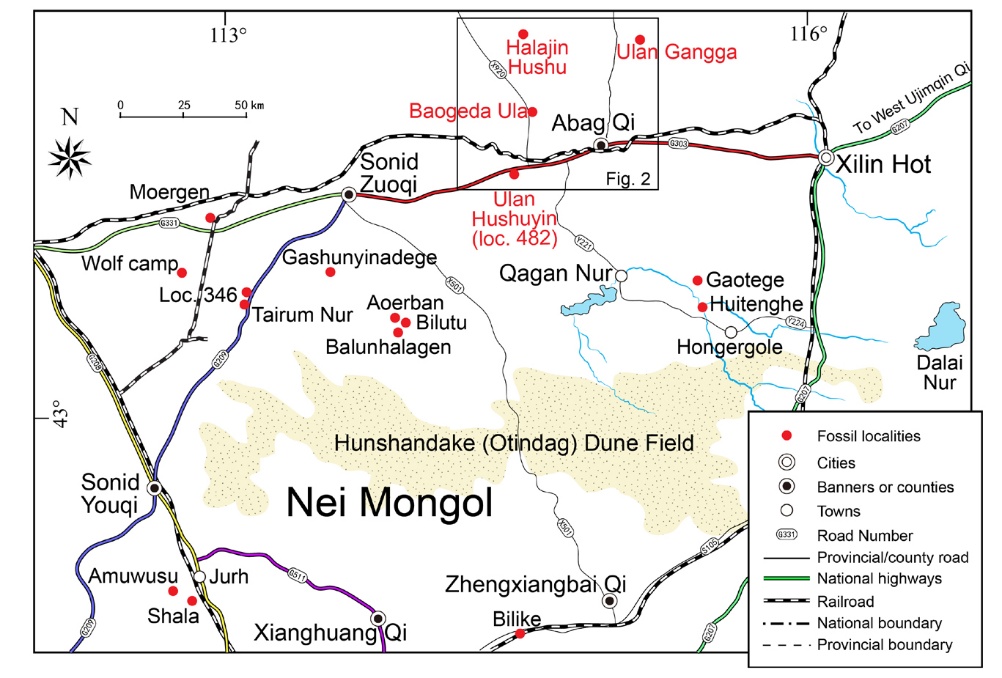
Fig. 1 Map of central Nei Mongol showing major Neogene fossil sites and locations of Fig. 2 (black rectangle) Modified from Qiu et al. (2021:fig. 1)
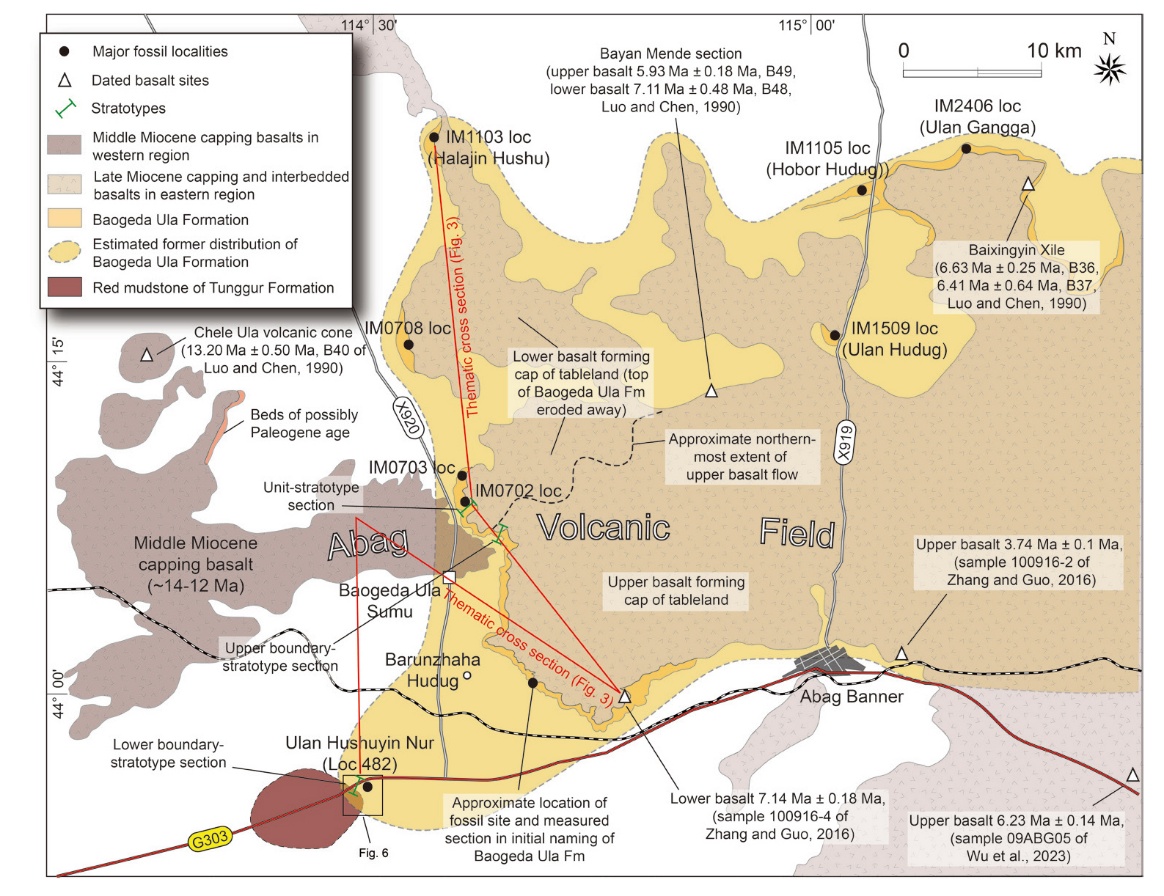
Fig. 2 Map of Baogeda Ula area showing major fossil localities, distribution of Neogene basalts (Abag Volcanic Field), basalt dating sites, Cenozoic sediments capped by the basalts, and estimated former distribution (see section 3.7) of Baogeda Ula Formation Black rectangle shows the location for Fig. 6
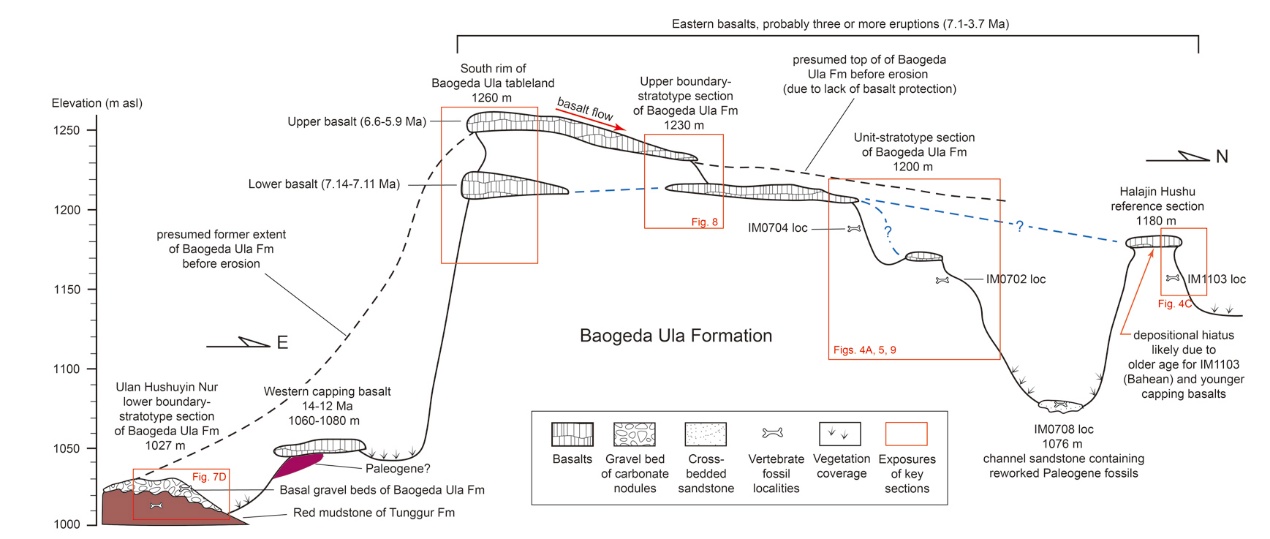
Fig. 3 Thematic relationships of sedimentary and volcanic strata in the Baogeda Ula area See straight red lines in Fig. 2 for orientations of how the individual sections are located Elevation (m above sea level) at top of local topographic heights are measured from Google Earth Pro (2024) and vertical exaggerations are approximately 232:1
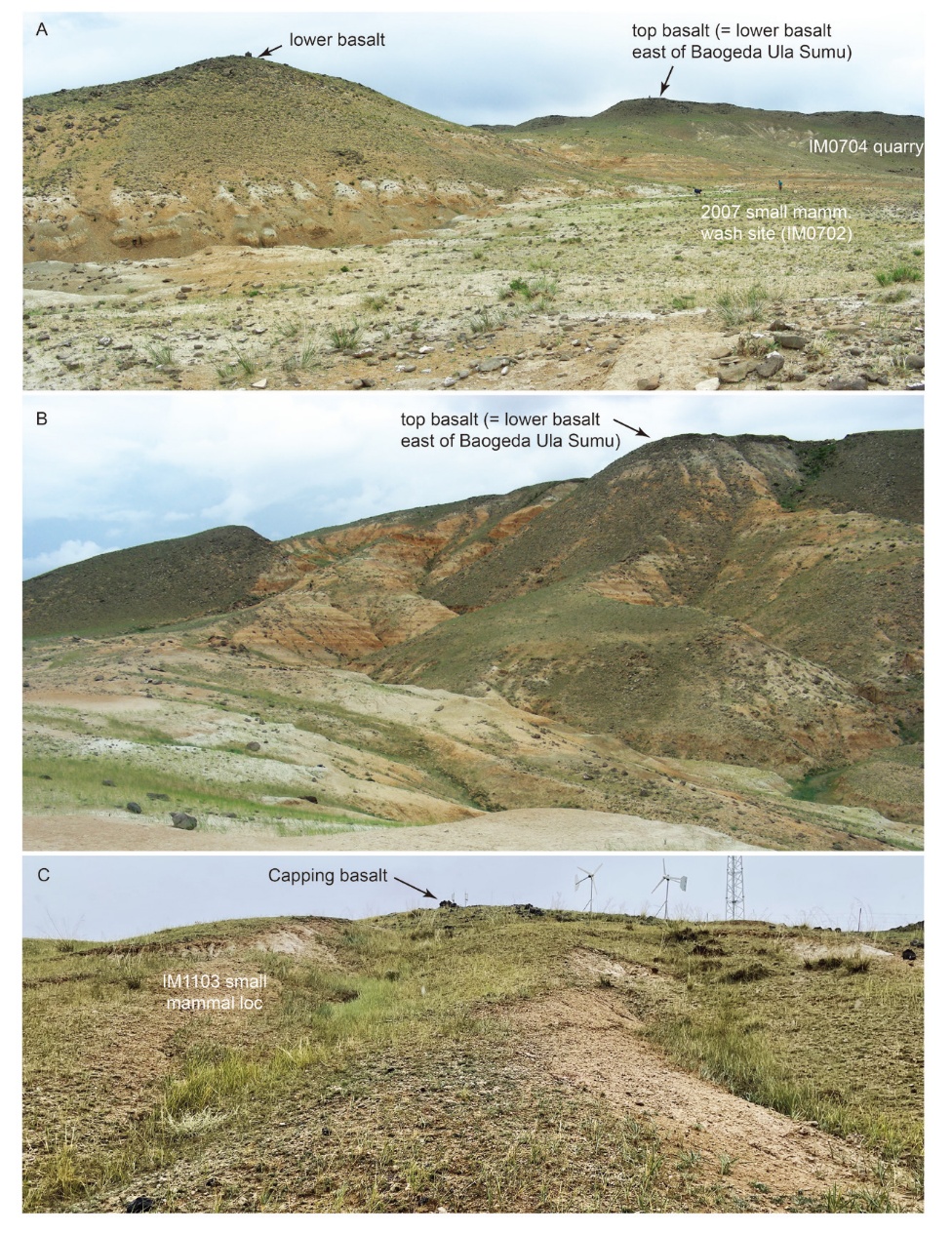
Fig. 4 Three sections of the Baogeda Ula Formation showing lithological variations A. unit-stratotype section at small mammal sampling site (IM0702) (the relatively high appearance of basalts on left hill is due to photographic perspective; it is substantially lower as shown in Fig. 9); B. section at IM0703 loc; C. a key reference section at Halajin Hushu. Photos by Wang Xiaoming
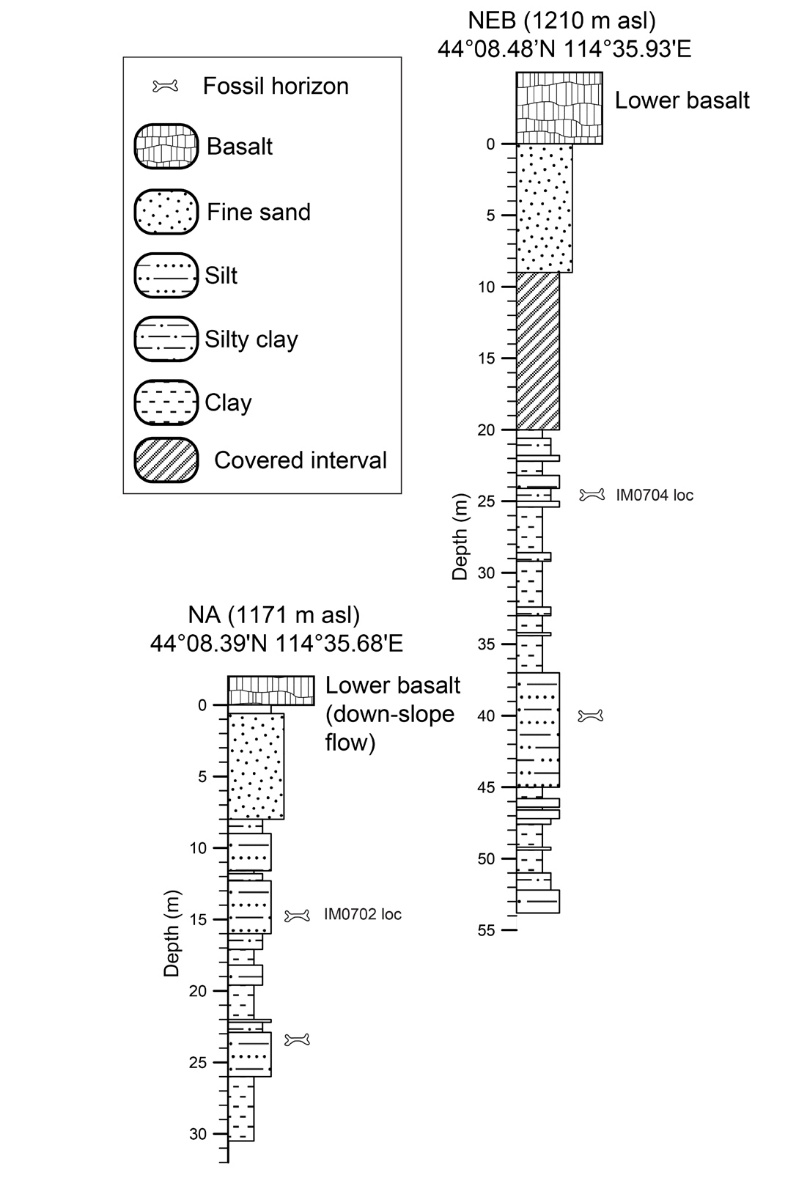
Fig. 5 Lithological section at unit-stratotype section of the Baogeda Ula Formation Modified from Sun et al. (2018:fig. 2). Due to a down-slope flow along an erosional topography, the lower basalts are exposed about 300 m apart and at markedly different elevations (see Fig. 9) These two capping basalts are starting points of the measured sections NA and NEB, terminology follow Sun et al. (2018)
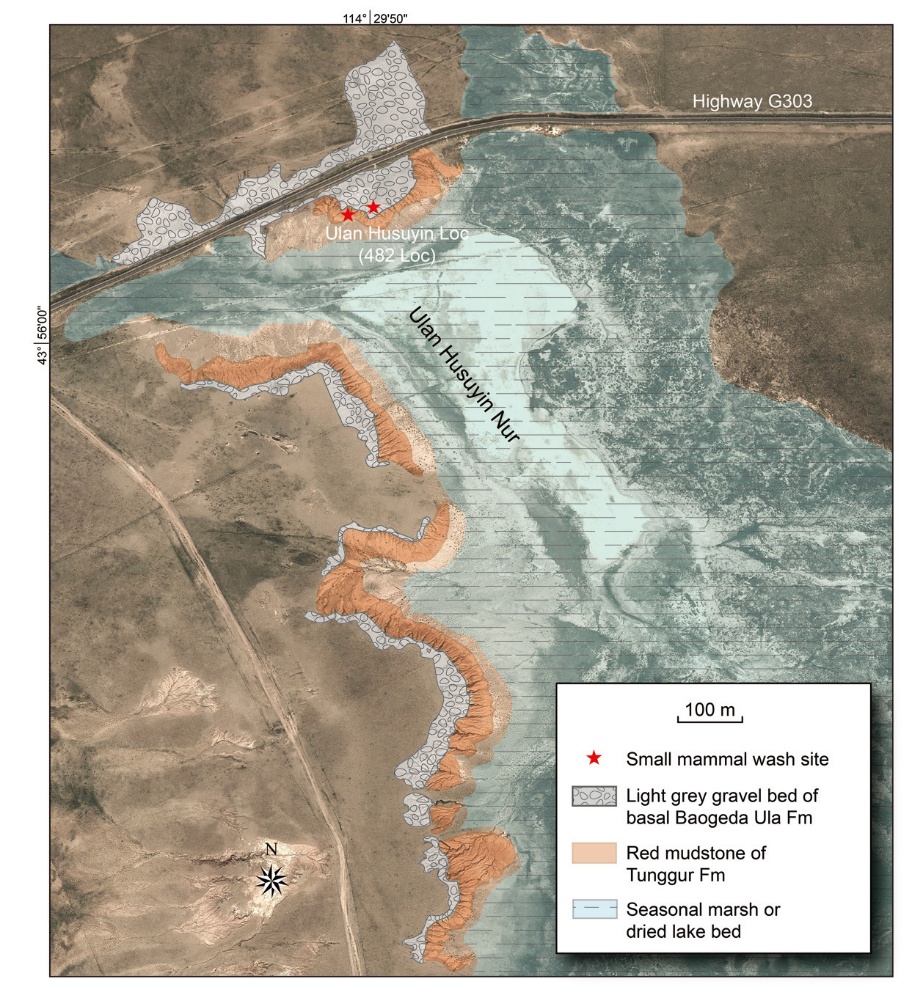
Fig. 6 Map of Ulan Hushuyin Nur area (previously known as the “Road Mark 482 locality”) and fossil sites Fine-grained red beds of Middle Miocene Tunggur Formation and capping light grey and whitish gravel beds of Upper Miocene Baogeda Ula Formation are shown along the shoreline of the ephemeral lake bed of Ulan Hushuyin Nur Google Earth satellite image (Google Earth Pro (Version 7.3.6.9796), 2024) was downloaded on August 9, 2023
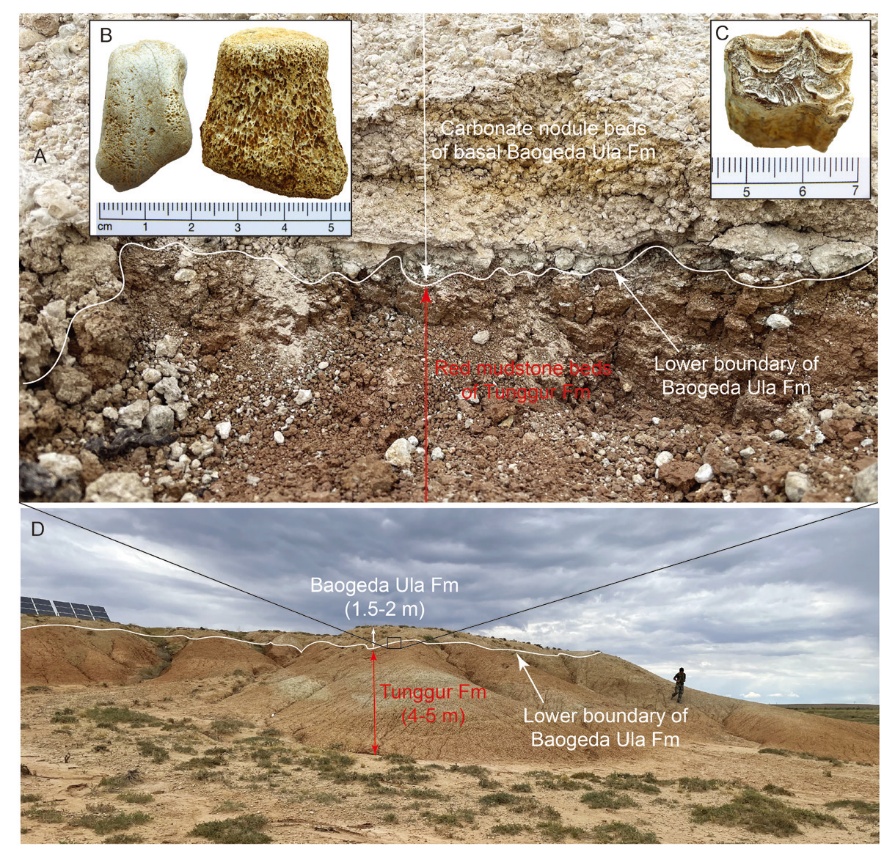
Fig. 7 Lower boundary-stratotype section in the Ulan Hushuyin site at an unconformable contact (white wavy line) between red mudstones of Middle Miocene Tunggur Formation in the lower part of the section (red arrows) and capping light grey and whitish gravel beds as the basal gravel beds of the Upper Miocene Baogeda Ula Formation (white arrows) A. close up of erosional contact relationship; B. water-worn postcranial fossils of large mammals found in the basal gravels of the Baogeda Ula Formation; C. field photo of a Hipparion cheek tooth within the upper white gravel beds; D. a broader view of the main section along the north shore of Ulan Hushuyin Nur Person in background for scale Photos taken by Wang Xiaoming on August 29, 2023 at N43°56′4.54″ E114°29′48.96″
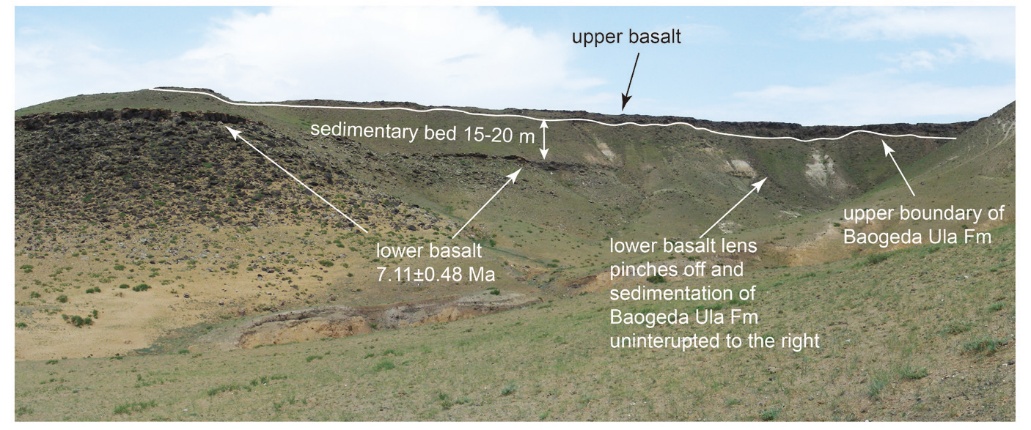
Fig. 8 Upper boundary-stratotype section of Baogeda Ula Formation, 6 km northeast of Baogeda Ula Sumu showing two distinct basalts The lower basalt is 15-20 m below the local capping upper basalt and can be seen to taper off toward the right side of photo. Field tracing as well as on Google Earth images suggest that the lower basalt became the capping basalt at the unit-stratotype section of Baogeda Ula Formation, as also concluded by Sun et al. (2018) We think this relationship matches with the section at Bayin Mende described by Luo and Chen (1990:fig. 6B), in which the lower basalt was dated to 7.11 Ma±0.48 Ma (sample B48), providing a key age constraint within Baogeda Ula Formation Photo looking toward the north by Wang Xiaoming on July 9, 2007 at N44°06′26.5″ E114°39′04.2″
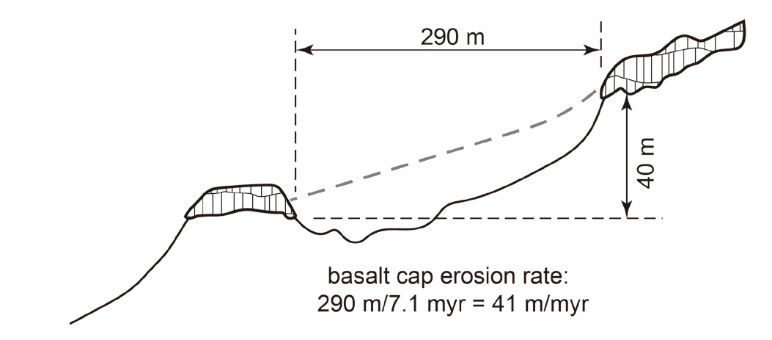
Fig. 9 Estimates of capping basalt lateral erosion rate at unit-stratotype section Based on photo in Sun et al. (2018:fig. 1C) with vertical exaggeration of 4:1
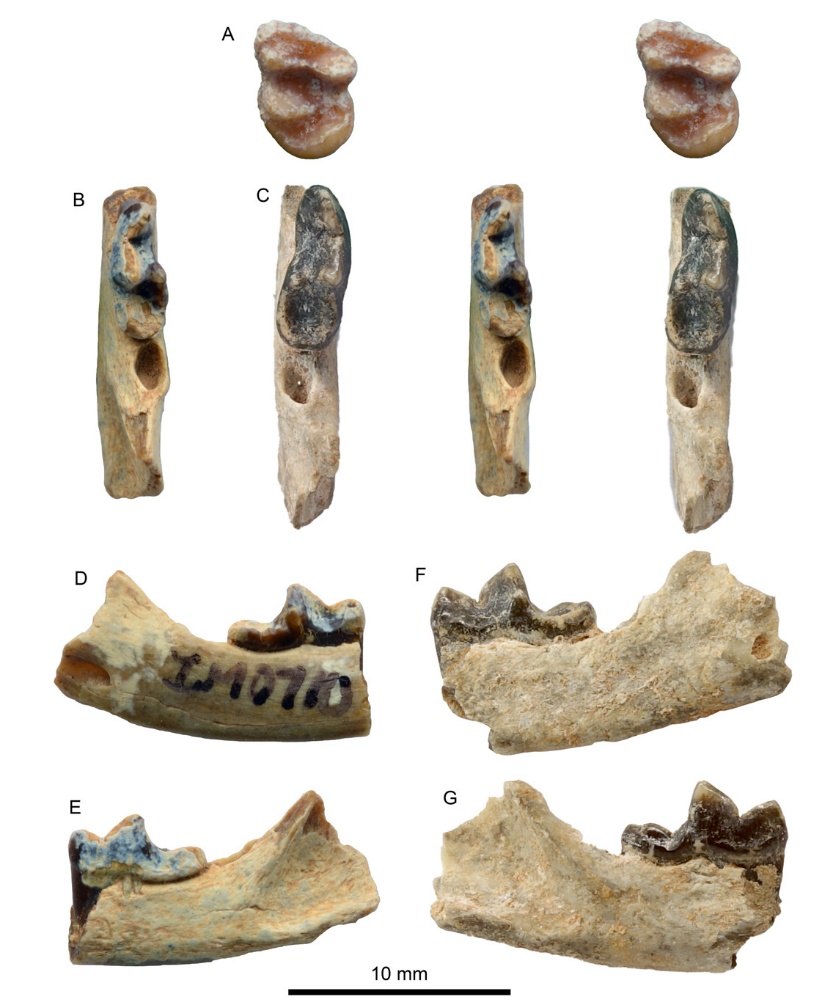
Fig. 10 Promephitis cf. P. parvus from Baogeda Ula Formation A. IVPP V34184, occlusal view (in stereo) of left M1 from IM0702 locality; B. V25146, occlusal view (in stereo) of left dentary fragment with m1 and m2 alveolus from Ulan Hushuyin locality (IM0710); C. V25174, occlusal view (in stereo) of right dentary fragment with m1 and m2 alveolus from Ulan Gangga locality; D. lingual and E. labial views of V25146; F. lingual and G. labial views of V25174
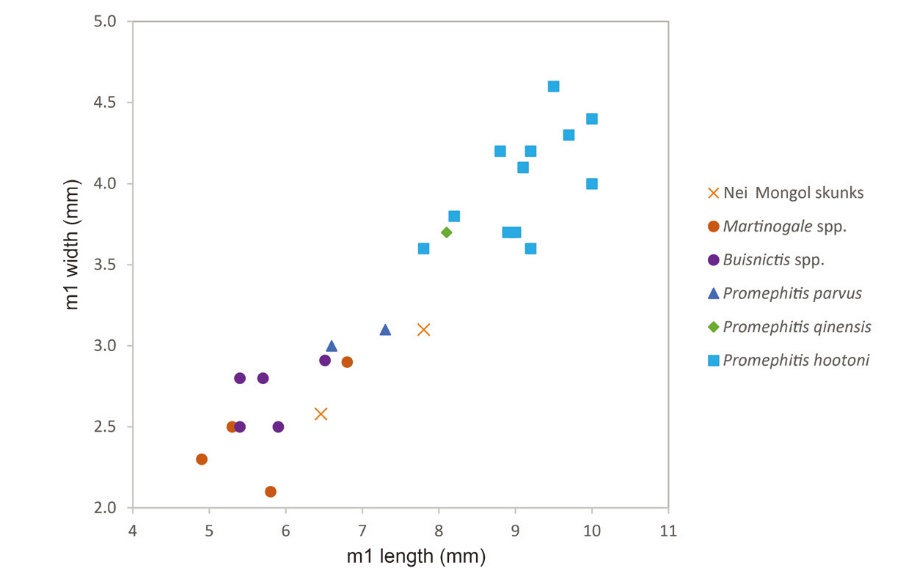
Fig. 11 Bivariate plot of lower m1 length (horizontal axis) and width (vertical axis) for select Chinese species of Promephitis and North American early skunks
| [1] |
Araslanov I F, Lavrov A V, 2024. Promephitis lartetii Gaudry, 1861 (Carnivora: Mephitidae) from the Late Miocene of Tuva (Taralyk-Cher Locality). Paleontol J, 58(2): 232-244
DOI |
| [2] | Barry T L, Kent R W, 1988. Cenozoic magmatism in Mongolia and the origin of central and east Asian basalts. In: Flower M, Chung S L, Lo C H et al. eds. Mantle Dynamicsa and Plate Interactions in East Asia. Washington: American Geophysical Union. 347-364 |
| [3] | Bureau of Geology and Mineral Resources of Inner Mongolia Autonomous Region (BGMR), Region, 1996. Lithostratigraphy of Inner Mongolia Autonomous Region. Research on Multiple Divisions and Comparisons in National Stratigraphy, vol. 15. Beijing: China University of Geoscience Press. 1-344 |
| [4] | Bureau of Geology and Mineral Resources of Nei Mongol Autonomous Region (BGMR), 1991. Regional Geology of Nei Mongol (Inner Mongolia) Autonomous Region. Geological Memoirs, Series 1. Beijing: Geological Publishing House. 1-725 |
| [5] |
Chen M, Niu F, Liu Q et al., 2015. Mantle-driven uplift of Hangai Dome: new seismic constraints from adjoint tomography. Geophys Res Lett, 42(17): 6967-6974
DOI URL |
| [6] | Chen S S, Fan Q C, Zhao Y W et al., 2013. Geochemical characteristics of basalts in Beilike area and its geological significance, Inner Mongolia. Acta Petrol Sin, 29(8): 2695-2708 |
| [7] |
Deng F L, Macdougall J D, 1992. Proterozoic depletion of the lithosphere recorded in mantle xenoliths from Inner Mongolia. Nature, 360: 333-336
DOI |
| [8] |
Deng T, Wang H, Wang X et al., 2016. The Late Miocene Hipparion (Equidae, Perissodactyla) fossils from Baogeda Ula, Inner Mongolia, China. Hist Biol, 28(1-2): 53-68
DOI URL |
| [9] |
Devyatkin Y V, Smelov S B, 1980. Position of basalts in the Cenozoic sedimentary sequence of Mongolia. Int Geol Rev, 22(3): 307-317
DOI URL |
| [10] | Editorial Committee of Chinese Geology, 1956. Regional Geologic Table of China (Draft). Beijing: Science Press. 1-693 |
| [11] | Editorial Committee of Stratigraphic Table of Inner Mongolia Autonomous Region (ECST), 1978. Regional Stratigraphic Table of North China (Inner Mongolia Autonomous Region). Beijing: Geological Publishing House. 1-338 |
| [12] | Gao Z J, Chen K Q, Wei J Y, 2000. Dictionary of the Lithostratigraphic Unit of China. Wuhan: China University of Geosciences Press. 1-628 |
| [13] | Gao Z J, Chen K Q, Gao L Z, 2014a. Dictionary of the Lithostratigraphic Unit of China (Part 1). Chengdu: Electronic Science and Technology University Publishing House. 1-646 |
| [14] | Gao Z J, Chen K Q, Gao L Z, 2014b. Dictionary of the Lithostratigraphic Unit of China (Part 2). Chengdu: Electronic Science and Technology University Publishing House. 1-700 |
| [15] |
Geraads D, Spassov N, 2016. Musteloid carnivores from the Upper Miocene of south-western Bulgaria, and the phylogeny of the Mephitidae. Geodiversitas, 38(4): 543-558
DOI URL |
| [16] |
Gong L, Li N, Fan Q et al., 2016. Mapping the topography and cone morphology of the Dalinor volcanic swarm in Inner Mongolia with remote sensing and DEM data. Front Earth Sci, 10(3): 578-594
DOI URL |
| [17] | Google Earth Pro (Version 7.3.6.9796), 2024. Available from https://www.google.com/work/earthmaps/earthpro.html. Mountain View, CA:Google Inc |
| [18] | He J, Huang W B, 1991. A new species of Promephitis from the Pliocene of Tongshan County, Jiangsu Province. Vert PalAsiat, 29(4): 303-313 |
| [19] |
He J, Wu Q, 2020. Mantle transition zone structure beneath the Central Asian Orogenic Belt. Sci China Earth Sci, 63(4): 548-560
DOI |
| [20] |
He J, Wu Q, Sandvol E et al., 2016. The crustal structure of south central Mongolia using receiver functions. Tectonics, 35(6): 1392-1403
DOI URL |
| [21] |
Ho K S, Liu Y A N, Chen J C et al., 2008. Elemental and Sr-Nd-Pb isotopic compositions of late Cenozoic Abaga basalts, Inner Mongolia: implications for petrogenesis and mantle process. Geochem J, 42(4): 339-357
DOI URL |
| [22] |
Kröner A, Kovach V, Belousova E et al., 2014. Reassessment of continental growth during the accretionary history of the Central Asian Orogenic Belt. Gondwana Res, 25(1): 103-125
DOI URL |
| [23] | Li S Z, 1996. Stratigraphy (Lithostratic) of Hebei Province. Multiple Classification and Correlation of the Stratigraphy of China, vol. 13. Wuhan: China University of Geosciences Press. 1-145 |
| [24] | Li Y T, 1984. The Tertiary System of China. Stratigraphy of China, 13. Beijing: Geological Publishing House. 1-362 |
| [25] | Liddicoat J C, 2009. Paleomagnetic evidence that south central Nei Mongol (Inner Mongolia) has had no measurable tectonic displacement since the Early Miocene (18 Ma to Present). American Geological Union 2009 Fall Meeting. San Francisco: American Geological Union |
| [26] | Liu J Q, 1999. Volcanos of China. Beijing: Science Press. 1-219 |
| [27] | Liu R X, Chen W J, Sun J Z et al., 1992. The K-Ar age and tectonic environment of Cenozoic rock in China. In: Liu R X ed. The Age and Geochemistry of Cenozoic Volcanic Rock in China. Beijing: Seismic Press. 1-43 |
| [28] | Luo X Q, Chen Q T, 1990. Preliminary study on geochronology for Cenozoic basalts from Inner Mongolia. Acta Petrol Mineral, 9(1): 37-46 |
| [29] | National Stratigraphic Committee, 2017. Chinese Stratigraphic Guide and Explanation, 2016 ed. Beijing: Geological Publishing House. 1-75 |
| [30] |
North American Commission on Stratigraphic Nomenclature, 2021. North American Stratigraphic Code. Stratigraphy, 18(3): 153-204
DOI URL |
| [31] | Pilgrim G E, 1933. A fossil skunk from Samos. Am Mus Novit, 663: 1-15 |
| [32] | Portenga E W, Bierman P R, 2011. Understanding Earth’s eroding surface with 10Be. GSA Today, 21(8): 4-10 |
| [33] | Qiu Z D, Li Q, 2016. Neogene rodents from central Nei Mongol, China. Palaeontol Sin, New Ser C, 30: 1-684 |
| [34] | Qiu Z D, Wang X, 1999. Small mammal faunas and their ages in Miocene of central Nei Mongol (Inner Mongolia). Vert PalAsiat, 37(2): 120-139 |
| [35] | Qiu Z D, Wang X, Li Q, 2006. Faunal succession and biochronology of the Miocene through Pliocene in Nei Mongol (Inner Mongolia). Vert PalAsiat, 44(2): 164-181 |
| [36] | Qiu Z D, Wang X, Li Q, 2013. Chapter 5. Neogene faunal succession and biochronology of central Nei Mongol (Inner Mongolia). In: Wang X, Flynn L J, Fortelius M eds. Fossil Mammals of Asia: Neogene Biostratigraphy and Chronology. New York: Columbia University Press. 155-186 |
| [37] | Qiu Z D, Wang X, Li Q et al., 2021. Late Miocene mammalian fauna of Halajin Hushu in Nei Mongol, China. Vert PalAsiat, 59(1): 19-44 |
| [38] | Qiu Z X, 2003. Dispersals of Neogene carnivorans between Asia and North America. In: Flynn L J ed. Vertebrate Fossils and Their Context: Contributions in Honor of Richard H. Tedford. Bull Am Mus Nat Hist, 279: 18-31 |
| [39] | Raffi I, Wade B S, Pälike H, 2020. Chapter 29, the Neogene Period. In: Gradstein F M, Ogg J G, Schmidtz M D et al. eds. Geologic Time Scale 2020. Amsterdam: Elsevier BV. 1141-1215 |
| [40] | Salvador A, 1994. International Stratigraphic Guide - A Guide to Stratigraphic Classification, Terminology, and Procedure. 2nd ed. International Subcommission on Stratigraphic Classification of IUGS International Commission on Stratigraphy. Boulder: Geological Society of America. 1-214 |
| [41] | Shao J, Ji J Q, Lu F X et al., 2008. Response of the continental lithosphere to the spreading mechanism: space-time distribution of the Meso-Cenozoic volcanic activities in the Liao-Meng geological corridor, China. Geol Bull China, 27(9): 1431-1440 |
| [42] |
Sun L, Deng C, Wang X et al., 2018. Magnetostratigraphic dating of the Late Miocene Baogeda Ula Formation and associated fauna in central Inner Mongolia, northern China. Palaeogeogr Palaeoclimat Palaeoecol, 505: 243-255
DOI URL |
| [43] | Teilhard de Chardin P, 1926a. Déscription de mammifères Tertiaires de Chine et de Mongolie. Ann Paléontol, 15: 1-52 |
| [44] | Teilhard de Chardin P, 1926b. Étude géologique sur la région du Dalai-Noor. Mém Soc Géol Fr, 7: 1-56 |
| [45] | Teilhard de Chardin P, 1945. Les Mustélidés de Chine; Première Partie. Les Formes Fossiles. Publ Inst Géobiol, 12: 1-37 |
| [46] |
Tseng Z J, Wang X M, 2007. The first record of the Late Miocene Hyaenictitherium hyaenoides Zdansky (Carnivora: Hyaenidae) in Inner Mongolia and an evaluation of the genus. J Vert Paleont, 27(3): 699-708
DOI URL |
| [47] | Wang X M, Li P, 2011. A new fossil site with a re-worked Paleogene assemblage at Baogeda Ula, central Nei Mongol. Vert PalAsiat, 49(1): 114-122 |
| [48] |
Wang X M, Qiu Z X, 2004. Late Miocene Promephitis (Carnivora, Mephitidae) from China. J Vert Paleont, 24(3): 721-731
DOI URL |
| [49] |
Wang X M, Qiu Z D, Opdyke N O, 2003. Litho-, bio-, and magnetostratigraphy and paleoenvironment of Tunggur Formation (Middle Miocene) in central Inner Mongolia, China. Am Mus Novit, 3411: 1-31
DOI URL |
| [50] |
Wang X M, Whistler D P, Takeuchi G T, 2005. A new basal skunk Martinogale (Carnivora, Mephitinae) from Late Miocene Dove Spring Formation, California, and origin of New World mephitines. J Vert Paleont, 25(4): 936-949
DOI URL |
| [51] | Wang X M, Tseng Z J, Takeuchi G T, 2012. Zoogeography, molecular divergence, and the fossil record - the case of an extinct fisher, Pekania palaeosinensis (Mustelidae, Mammalia), from the Late Miocene Baogeda Ula Formation, Inner Mongolia. Vert PalAsiat, 50(3): 293-307 |
| [52] | Whitford-Stark J L, 1987. A survey of Cenozoic volcanism on mainland Asia. Geol Soc Am Spec Pap, 213: 1-74 |
| [53] |
Windley B F, Allen M B, 1993. Mongolian plateau: evidence for a late Cenozoic mantle plume under central Asia. Geology, 21(4): 295-298
DOI URL |
| [54] |
Windley B F, Alexeiev D, Xiao W et al., 2007. Tectonic models for accretion of the Central Asian Orogenic Belt. J Geol Soc, 164(1): 31-47
DOI URL |
| [55] | Wu Y, Bao X, 2023. Cenozoic uplift and volcanism of Hangai Dome, central Mongolia triggered by lower mantle upwellings. Geophys Res Lett, 50(8): e2023GL102838 |
| [56] | Wu Y, Zhao Y W, Li N et al., 2023. Whole-rock 40Ar/39Ar geochronology of late Cenozoic lava platform in Xilin Gol, Inner Mongolia. Acta Petrol Sin, 39(1): 159-169 |
| [57] |
Zhang L, Huang Z, Song X et al., 2024. A review of geophysical studies on the Mongolian Plateau. Earthq Sci, 37(3): 224-240
DOI URL |
| [58] |
Zhang M L, Guo Z F, 2016. Origin of Late Cenozoic Abaga - Dalinuoer basalts, eastern China: implications for a mixed pyroxenite-peridotite source related with deep subduction of the Pacific slab. Gondwana Res, 37: 130-151
DOI URL |
| [59] | Zheng J J, He X X, Liu S W, 1999. Stratigraphical Lexicon of China:Tertiary System. Beijing: Geological Publishing House. 1-163 |
| [1] | 邱铸鼎, 王伴月, 李录. 甘肃晚中新世伊哈池地点的仓鼠化石. 古脊椎动物学报, 2026, 64(1): 1-25. |
| [2] | 李录, 李强, 王晓鸣. 内蒙古瘤齿短面猬(劳亚食虫目,猬科)新材料兼论中国的短面猬类. 古脊椎动物学报, 2025, 63(4): 335-349. |
| [3] | 邓涛. 从黄海之滨到青藏高原:邱占祥先生的学术高度. 古脊椎动物学报, 2025, 63(4): 253-265. |
| [4] | 拉纳·梅赫罗斯·法扎尔, 贺战武, 杜抱朴, 常美静, 史静耸, 倪喜军, 李强, 赵凌霞. 桂林盆地发现更新世棕果蝠及其伴生非飞行小哺乳动物化石. 古脊椎动物学报, 2025, 63(3): 173-188. |
| [5] | 李岚馨, 李茜. 对晚始新世古蒙语鼠相似种(啮齿目:壮鼠科)的综合研究. 古脊椎动物学报, 2025, 63(3): 189-209. |
| [6] | 王伴月, 邱铸鼎, 李录. 甘肃临夏盆地广河县古城的早中新世小哺乳动物化石. 古脊椎动物学报, 2025, 63(2): 102-132. |
| [7] | 李春晓, 汤建荣, 王世骐, 王林昌, 郑迎凯, 邓克, 林敏, 陈润生, 周国武, 陈中央. 中国东南地区首次发现新近纪象化石. 古脊椎动物学报, 2025, 63(1): 43-56. |
| [8] | 穆罕默德·伊利亚斯, 李强, 史勤勤, 倪喜军. 欧亚大陆晚中新世 “麝牛类” 牛科动物. 古脊椎动物学报, 2024, 62(4): 262-290. |
| [9] | 李春晓, 陈津, 王世骐. 间型三棱齿象(Trilophodon connexus Hopwood, 1935)属于豕棱齿象类而非嵌齿象. 古脊椎动物学报, 2024, 62(1): 33-46. |
| [10] | Anek R. SANKHYAN, Olivier CHAVASSEAU. 印度Haritalyangar地区晚中新世猪类化石新材料. 古脊椎动物学报, 2024, 62(1): 69-84. |
| [11] | 劳伦斯J.弗林, 李强, 吉学平, 王晓鸣. 云南晚中新世一巨型竹鼠. 古脊椎动物学报, 2023, 61(4): 277-283. |
| [12] | 山显任, 林翔鸿, 张雨萌, 李旭彤, 盖志琨. 西域鱼在江西和塔里木盆地志留系的新发现. 古脊椎动物学报, 2023, 61(4): 245-260. |
| [13] | 李世杰, 邓涛. 河北磁县九龙口中中新世动物群中真犀的再研究. 古脊椎动物学报, 2023, 61(3): 198-211. |
| [14] | 张晓晓, 杨絮, 孙燕, 王洪江, 杨蓉, 陈善勤, 王世骐, 李虹. 中国中新世轭齿象类新材料及有关分类厘定. 古脊椎动物学报, 2023, 61(2): 142-160. |
| [15] | 李琪, 李茜. 内蒙古二连盆地沙拉木伦期啮齿类动物群研究. 古脊椎动物学报, 2023, 61(1): 43-70. |
| 阅读次数 | ||||||
|
全文 |
|
|||||
|
摘要 |
|
|||||
