Ceratopsia is among the most extensively studied groups of dinosaurs. However, research on ceratopsian osteohistology remains extremely limited, leaving significant gaps in our understanding of their growth rates, growth patterns, and life histories. This study presents a detailed histological analysis of the fibulae and ribs from two Liaoceratops yanzigouensis specimens (IVPP V18616 and V17910). V18616 was identified as a juvenile, estimated to be less than one year old, while V17910 was classified as a subadult, at least three years of age. The results indicate that Liaoceratops experienced rapid growth during its juvenile stage, with fibrolamellar bone dominating the cortical bone. By the subadult stage, the growth rate had gradually slowed. This study also highlights the importance of standardized sampling protocols, as evidenced by the rib sections. The feasibility of conducting comparative studies is constrained by the non-standardized sampling locations. The presence of LAGs (Lines of Arrested Growth) in V17910 suggests that Liaoceratops had a cyclical, interrupted growth pattern. In contrast to the continuous growth seen in chasmosaurinae, early-diverging neoceratopsians may have predominantly experienced cyclic growth interruptions.
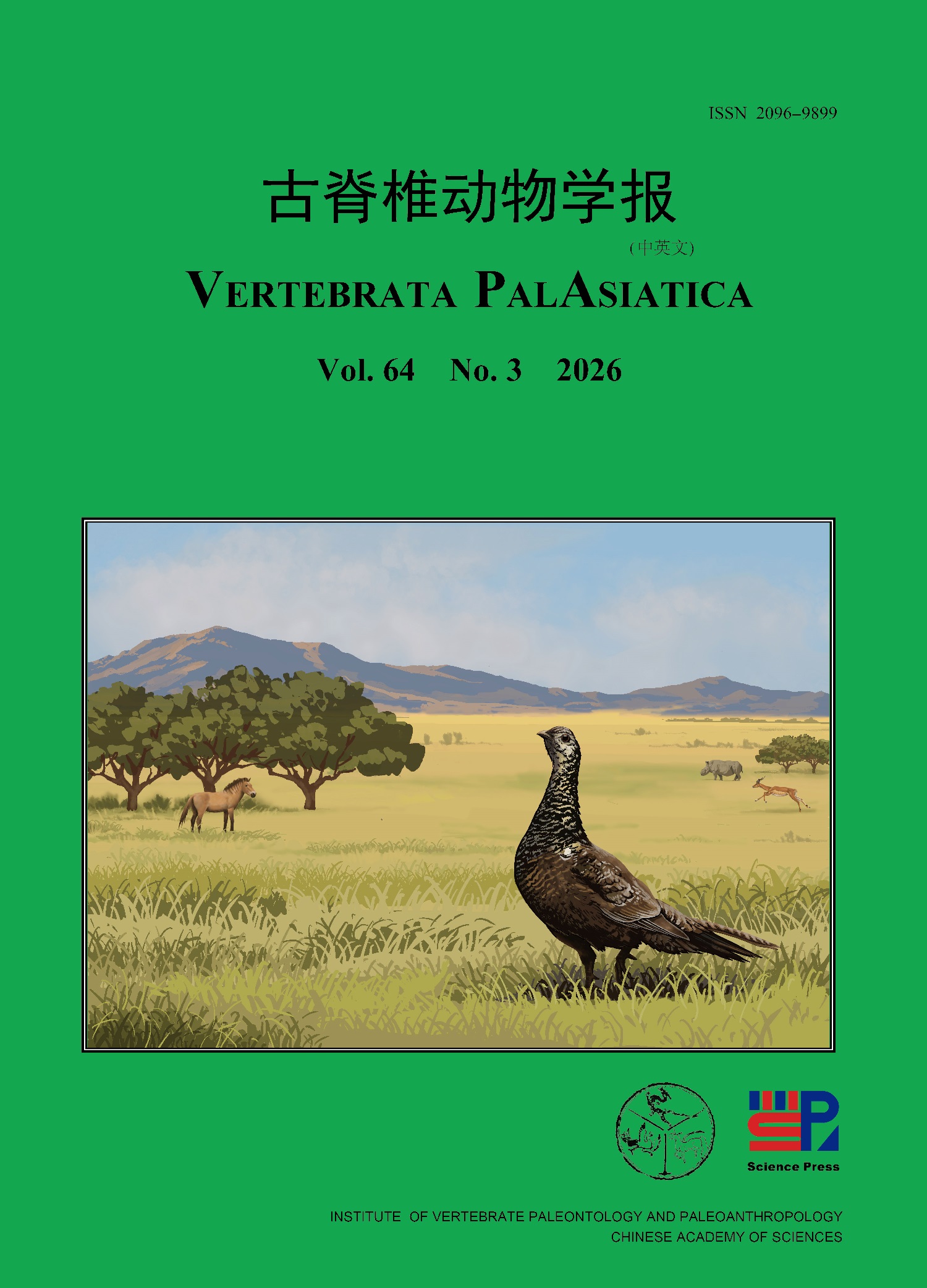
The Linxia Basin, located in Northwest China at the edge of the Tibetan Plateau, preserves a rich fossil record of mammals and birds. Here, we report an exquisitely preserved skeleton representing a new species of small-bodied phasianid from the Linxia Basin, dated to approximately the latest Miocene to Early Pliocene. Gracilisgallus linxia represents the first discovery in China of a taxon closely related to extant grouse and turkey. The new species exhibits a small body size and slender limb bones. Phylogenetic analysis supports its close relationship with extant grouse (Tetraoninae) and turkey (Meleagridinae). The scapula, carpometacarpus, femur, and tarsometatarsus of Gracilisgallus linxia share morphological similarities with its extant relatives, but diagnostic features—such as relatively long spurs on the tarsometatarsus—support its classification as a distinct genus and species, separate from both turkey and grouse. This fossil provides a Late Miocene to Early Pliocene calibration point for the divergence of the turkey—grouse lineages and reveals complex patterns in their radiation across North America and eastern Asia.
The Early Pleistocene Yeka Fauna was first identified during the Hengduan Mountains Scientific Expedition in the 1980s. New mammal fossil remains were collected during the execution of the Second Tibetan Plateau Scientific Expedition and Research Project (STEP) in 2020 and 2024. The most recent findings have been identified as 5 orders, 12 families, 15 genera, and 15 species. The updated Shangri-La fossil mammal combination (Yeka and Zhongdian faunas) has been compared to several Early Pleistocene faunas in China. It has been found to be most closely correlated to the Yuanmou Man Fauna. The faunal composition of the Shangri-La fossil mammal combination is distinguished by the co-occurrence of boreal and austral elements, a pattern that is analogous to the modern biogeography observed in the Hengduan Mountains. Faunal analysis suggests that during the Early Pleistocene, the Shangri-La region was characterized by a moderate-elevation forest intermingled with open grassland.
Here we describe an incomplete dinosaur egg nest composed of 12 subspherical dinosaur eggs from Xiuning, southern Anhui Province, China. The eggshell measures about 1 mm in average thickness and is generally comprised of only one layer, although 2-3 layers of eggshell unit can be seen in some places of the eggshell radial section. The pore canals appear honeycomb-like in tangential section, and are characterized by a density of 12 per mm2 in the middle part of eggshell, and diameters between 0.14 and 0.34 mm. Based on these characteristics, we erect Parafaveoloolithus wannanensis oosp. nov. to accommodate the eggs from Xiuning, which clearly belong to Parafaveoloolithus but differ from all previously known oospecies within the Faveoloolithidae. This occurrence of the new oospecies P. wannanensis increases the diversity of dinosaur egg types in southern Anhui Province, extends the previously known distribution of Parafaveoloolithus, and provides more paleontology evidence to help comparison of the Cretaceous strata of southern Anhui Province.