Please wait a minute...
Welcome to Visited Vertebrata Palasiatica, Today is
IMAGE/TABLE DETAILS
New materials of Exallerix pustulatus (Erinaceidae, Eulipotyphla) from Nei Mongol and other Brachyericinae of China
LI Lu, LI Qiang, WANG Xiao-Ming
Vertebrata Palasiatica    2025, 63 (4): 335-349.   DOI: 10.19615/j.cnki.2096-9899.250910
Abstract   (981 HTML20 PDF(pc) (2341KB)(227)  

This article describes new fossil material of Exallerix pustulatus from the early Late Oligocene of Nei Mongol, China. The specimens supplement and clarify certain mandibular and lower dental morphological features of this species, allowing for further comparisons with other short-faced hedgehogs. Previously, E. pustulatus had only been recorded from the Hsanda Gol Formation at Taatsiin Gol, in the Valley of Lakes, Mongolia. This discovery of new material from Sonid Left Banner marks the first occurrence of the genus Exallerix in China. In addition, discussions of other short-faced hedgehog fossils from Chinese localities confirm the validity of Metexallerix gaolanshanensis, which lived during the late Late Oligocene, approximately 25 Ma. Furthermore, the short-faced hedgehog specimens from locality Damiao 16 in Nei Mongol are tentatively referred to Synexallerix junggarensis, rather than M. gaolanshanensis.


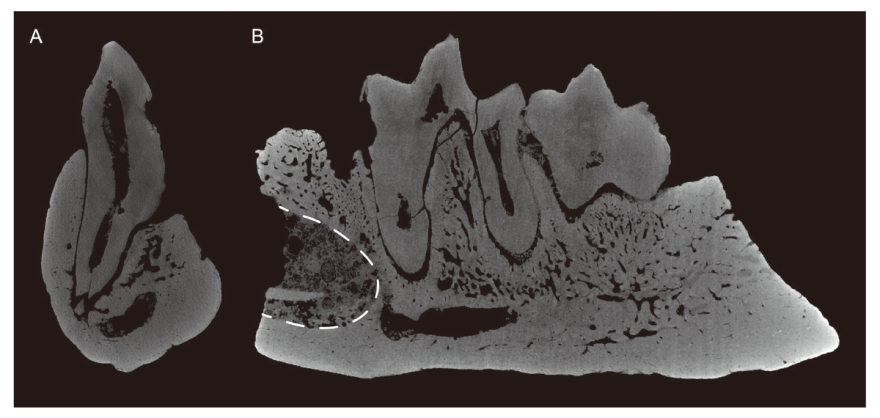
Fig. 3 CT graphs of mandibular fragment of Exallerix pustulatus (IVPP V34183.2)
A. transverse plane, through anterior root of the m1, anterior view; B. sagittal plane, lateral view, the white dashed line shows the alveolus of the i1
Extracts from the Article
There are three alveoli between the i1 and p4. As described by Ziegler et al. (2007), these correspond to three single-rooted premolars: i2, c, and p3. The i2 alveolus in IVPP V34183.1 is notably smaller than that in V34183.5. The p4 alveoli are anteroposteriorly compressed ovals, with the posterior alveolus slightly larger than the anterior one. These two alveoli are either partially fused (V34183.6) or completely separated (V34183.2). All alveoli and erupted teeth are strongly inclined labially (Fig. 3A), resulting in their labial margins being distinctly more ventrally positioned than their lingual counterparts (Ziegler et al., 2007). This condition varies in degree among Metexallerix gaolanshanensis and Synexallerix junggarensis (Qiu and Gu, 1988; Bi, 1999), as well as other Asian species of Exallerix, but has not been observed in Brachyerix or Metechinus from North America.
The i1: in cross-section, the crown is nearly semicircular, except on the medial side where it is straight, as seen in Metechinus amplior (Rich, 1981). The anteroposterior diameter of the tooth is significantly greater than its transverse dimension. The labial surface is more exposed beyond the alveolus than the medial surface. The root of the i1 extends posteriorly to the front of the anterior root of the m1 (Fig. 3B), a feature also observed in Exallerix hsandagolensis (McKenna and Holton, 1967). The labial surface of the i1 displays extensive enamel ornamentation.
Other Images/Table from this Article