
古脊椎动物学报 ›› 2021, Vol. 59 ›› Issue (3): 229-244.DOI: 10.19615/j.cnki.1000-3118.210309CSTR: 32090.14.j.cnki.1000-3118.210309
李志恒1,2( ), 艾莉达1,2, Thomas A. STIDHAM1,2,3, 王敏1,2, 邓涛1,2,3
收稿日期:2020-12-25
出版日期:2021-07-20
发布日期:2021-07-20
通讯作者:
lizhiheng@ivpp.ac.cn基金资助:
LI Zhi-Heng1,2(), Alida M. BAILLEUL1,2, Thomas A. STIDHAM1,2,3, WANG Min1,2, DENG Tao1,2,3
Received:2020-12-25
Published:2021-07-20
Online:2021-07-20
摘要:
报道了来自西北地区中新世晚期临夏盆地的一件鸵鸟化石,该标本包括鸵鸟的部分颈椎以及气管,由于缺乏物种级别的鉴定特征,被暂定为鸵鸟(Struthio sp.)。新标本还保留了平齿三趾马(Hipparion platyodus)的部分头骨。利用多种分析测试方法,对该鸵鸟骨骼的微观特征进行了详细研究,以探讨临夏鸵鸟的埋藏条件和古气候背景。在鸵鸟化石的一个脱矿化的骨碎片中发现了软组织(内源性血管和红细胞的化石残留)。同时光学显微镜和扫描电镜成像显示,化石组织切片中存在显著的细菌改变(骨侵蚀现象)。这是中新世临夏盆地脊椎动物遗体中软组织的首次报道。通过相关的地质和沉积学证据与新的古生物数据相结合,认为季风气候可能是造成鸟类化石早期埋葬期间微生物侵蚀的原因,接下来延续了8 Ma左右的盆地剧烈的干旱化作用,导致了微生物活动的停止,并进一步导致了成岩作用后期孔隙方解石的沉淀。这项工作显示出跨学科(包括形态学、沉积学、地球化学和软组织分析)研究可以更好地揭示中国西北临夏盆地柳树组的中新世晚期的动物群更替、气候和分子保存。
中图分类号:
李志恒, 艾莉达, Thomas A. STIDHAM, 王敏, 邓涛. 临夏盆地晚中新世鸵鸟化石的特异保存. 古脊椎动物学报, 2021, 59(3): 229-244.
LI Zhi-Heng, Alida M. BAILLEUL, Thomas A. STIDHAM, WANG Min, DENG Tao. Exceptional preservation of an extinct ostrich from the Late Miocene Linxia Basin of China. Vertebrata Palasiatica, 2021, 59(3): 229-244.
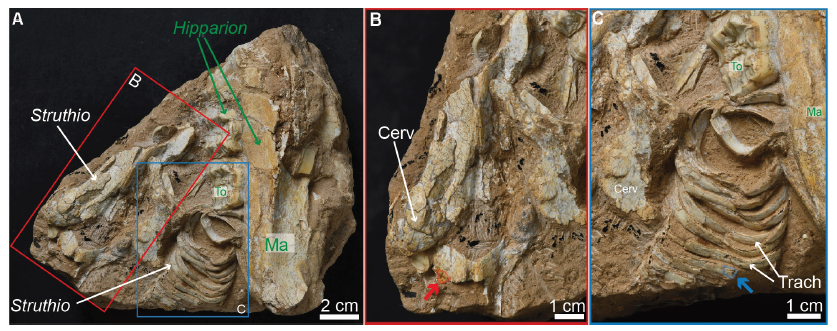
Fig. 1 Photographs of the fossil block (IVPP V 25336) from the Liushu Formation in Linxia Basin A. the block contains an assemblage of two species, with Struthio sp. (ostrich) cervical bones on the left side and a partial right maxilla of Hipparion platyodus on the right; B. close-up on the ostrich cervical vertebrae with a red arrow indicating the location of the fragment extracted; C. close-up of the ostrich tracheal rings, with a blue arrow showing where the fragment was extracted Abbreviations: Cerv. cervical vertebra; Ma. maxilla; To. tooth; Trach. tracheal rings
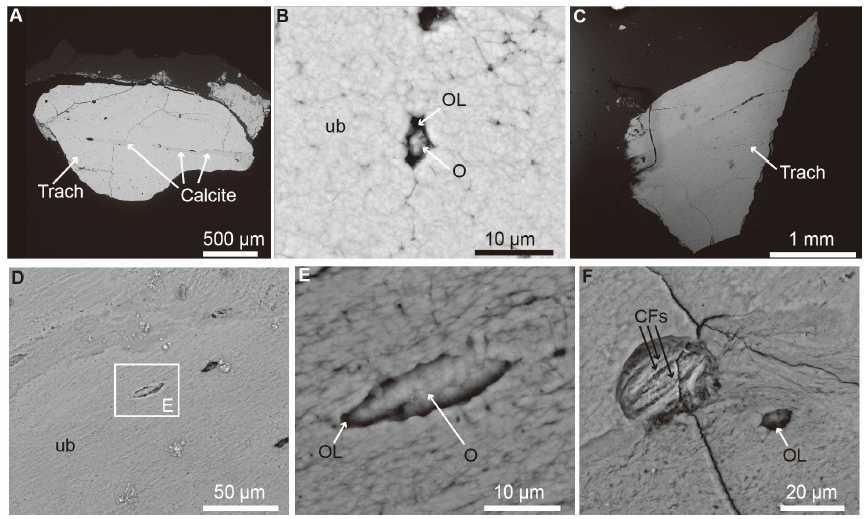
Fig. 2 SEM photographs of the fragment of fossil ostrich trachea (IVPP V 25336) A. corresponding SEM image of tracheal sections in Fig. 4. It shows compact bone with very few vascular spaces and calcite infillings in the vascular spaces. B. SEM close-up of well-preserved bone, with an osteocyte lacuna. Some intralacunar material is present, and it is most likely the fossilized remnants of an original osteocyte. C. second histological cross section of the fragment. D. close-up of unaltered bone and osteocyte lacunae. E. high magnification on the osteocyte lacuna filling, most likely a fossilized remnant of the original ostrich osteocyte. F. close-up of porous area with exposed fibrous material, undoubtedly collagen fibers Abbreviations: CFs. fossilized collagen fibers; O. fossilized remnant of osteocyte; OL. osteocyte lacuna; Trach. tracheal ring; ub. unaltered bone matrix
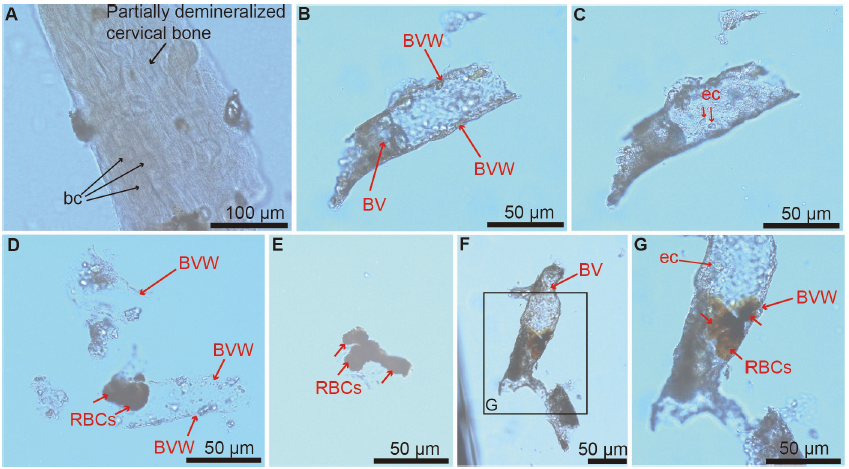
Fig. 3 Photomicrographs of another demineralized fragment of Struthio cervical bone (IVPP V 25336) A. partially demineralized bone using EDTA in sterile conditions. The bone is translucent and bacterial colonies are clearly visible. B. fossilized remnants of original blood vessels (freed from the bone matrix after complete demineralization) which present the same morphological characteristics of extant ostrich blood vessels (Schweitzer et al., 2005, 2007). The vessel is hollow, translucent, and shows clear walls. C. same image as panel B shown in a slightly different focal depth to emphasize remnants of fossilized endothelial cell nuclei within the blood vessel walls. D. fragment of blood vessel with round brown microstructures that are consistent in location and morphology with fossilized blood content. E. fossilized intravascular content (potential blood breakdown products). F. fragment of blood vessel with internal content. G. close-up of endothelial cells in the thick blood vessel walls, and three distinct, circular to oval, brown structures that are most likely the fossilized remnants of original red blood cells This vessel is not complete, but a branching pattern is obvious Abbreviations: bc. bacterial colony; BV. fossilized remnant of original blood vessel; BVW. fossilized remnant of blood vessel walls; ec. fossilized remnants of endothelial cell nuclei; RBCs. fossilized remnants of original red blood cells
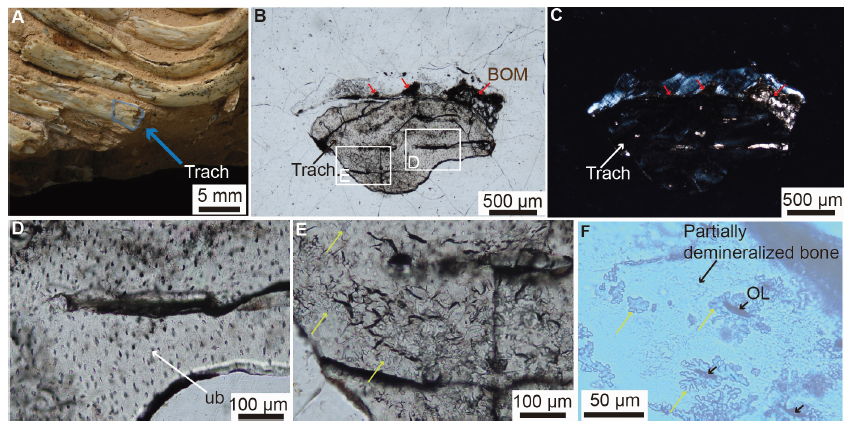
Fig. 4 Photographs of the fragment of fossil ostrich trachea (IVPP V 25336) A. photograph of the fragment (outlined in blue) prior to extraction; B. first histological cross section of the fragment seen under transmitted light; C. same image seen under polarized light, some brown material, potentially original soft-tissues with remnants of organic molecules is on top of the trachea; D. close-up of unaffected bone with no evidence of bacterial invasion; E. close-up of unaffected bone with dendritic structures (yellow arrows); F. partially demineralized bone with dendritic structures (yellow arrows) They emanate from the osteocyte lacunae, but are also present directly on the bone matrix so they may represent some type of diagenetic recrystallization Abbreviations: BOM. potential brown organic matter; OL. osteocyte lacuna; Trach. tracheal ring; ub. unaltered bone matrix
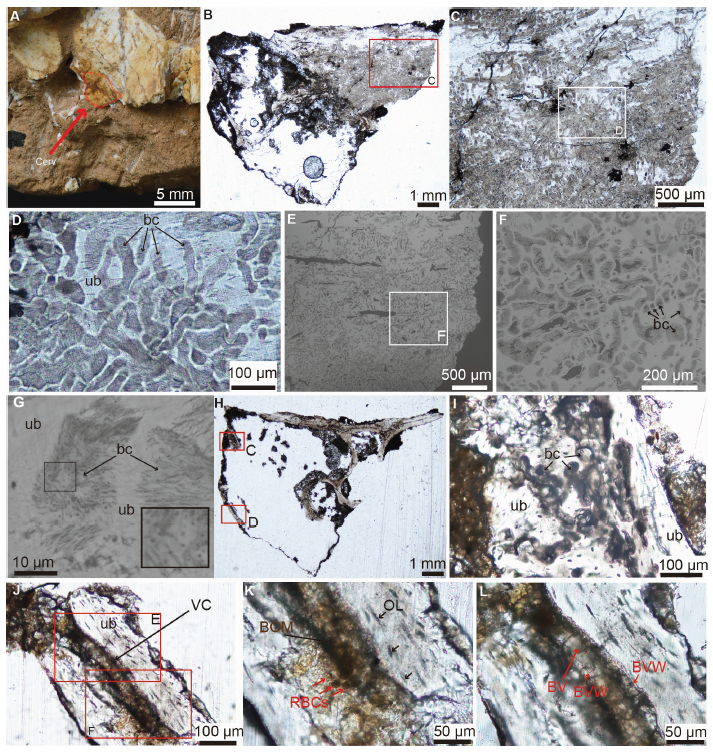
Fig. 5 Histological and SEM photographs of the fragment of Struthio sp. cervical vertebra (IVPP V 25336) A. photograph of the fragment prior to extraction, outlined in red; B. histological cross section of the fragment under transmitted light; C. close-up showing highly altered bone microstructure; D. higher magnification shows elongated, beige areas that correspond to bacterial colonies within a lighter and unaffected bone matrix; E. corresponding SEM image of (C); F. a close-up of the bacterial colonies under the SEM; G. Higher magnification shows that the colonies are characterized by thin channels and pores (bc); H. second histological cross section of the fragment, with high pneumaticity and little amounts of bone; I. close-up showing microbially attacked bone; J. close-up on another region showing unaltered bone (without any bacterial colonies) and a vascular canal in the center; K. close-up of the vascular canal shows it is filled with a brown material, most likely organic remnants, some round structures are also seen, and they present the right size and location to be the fossilized remnants of original red blood cells; L. close-up (slightly more dorsal) shows a hollow, tubular structure with walls. It presents all of the morphological characteristics of extant ostrich blood vessels and blood vessel walls (Schweitzer et al., 2005, 2007) All light microscopy photographs in this figure are shown under transmitted light Abbreviations: bc. bacterial colony; BOM. potential brown organic matter; BV. blood vessel (or fossilized remnants of original blood vessel); BVW. blood vessel wall (or fossilized remnants of original blood vessel wall); Cerv. cervical vertebra; OL. osteocyte lacuna; RBCs. red blood cells; ub. unaltered bone matrix; VC. vascular canal
| [1] | An Z, 2014. Late Cenozoic climate change in Asia: loess, monsoon and monsoon-arid environment evolution. Dordrecht Heidelberg, New York, London: Springer Science & Business Media. 1-587 |
| [2] |
An Z, Kutzbach J E, Prell W L et al., 2001. Evolution of Asian monsoons and phased uplift of the Himalaya-Tibetan plateau since Late Miocene times. Nature, 411:62-66
DOI URL |
| [3] | Atalgin S H, Ates S, Kurtul I et al., 2018. Mineralization in the syrinx and caudal tracheal rings in the ostrich. Indian J Anim Res, 52:33-36 |
| [4] |
Bailleul A M, O’Connor J K, Li Z H et al., 2020. Confirmation of ovarian follicles in an enantiornithine (Aves) from the Jehol biota using soft tissue analyses. Commun Biol, 3:399
DOI PMID |
| [5] |
Briggs D E G, 2003. The role of decay and mineralization in the preservation of soft-bodied fossils. Annu Rev Earth Plant Sci, 31:275-301
DOI URL |
| [6] |
Cobley M J, Rayfield E J, Barrett P M, 2013. Inter-vertebral flexibility of the ostrich neck: implications for estimating sauropod neck flexibility. PLoS One, 8:e72187
DOI URL |
| [7] | Deng T, 2005. Character, age and ecology of the Hezheng Biota from northwestern China. China. Acta Geol Sin-Engl, 79:739-750 |
| [8] | Deng T, 2009. Late Cenozoic environmental changes in the Linxia Basin (Gansu, China) as indicated by cenograms of fossil mammals. Vert PalAsiat, 47:282-298 |
| [9] | Deng T, Wang X M, Ni X J et al., 2004. Sequence of the Cenozoic mammalian faunas of the Linxia Basin in Gansu, China. Acta Geol Sin-Engl, 78:8-14 |
| [10] | Deng T, Qiu Z X, Wang B Y et al., 2013. Late Cenozoic biostratigraphy of the Linxia Basin, northwestern China. In: Wang X M, Fortelius M, Flynn L eds. Fossil Mammals of Asia: Neogene Biostratigraphy and Chronology. New York: Columbia University Press. 243-273 |
| [11] |
Fan M, Dettman D L, Song C et al., 2007. Climatic variation in the Linxia Basin, NE Tibetan Plateau, from 13.1 to 4.3 Ma: the stable isotope record. Palaeogeogr, Palaeoclimatol, Palaeoecol, 247:313-328
DOI URL |
| [12] |
Fang X, Garzione C, Van der Voo R et al., 2003. Flexural subsidence by 29 Ma on the NE edge of Tibet from the magnetostratigraphy of Linxia Basin, China. Earth Planet Sci Lett, 210:545-560
DOI URL |
| [13] |
Fernández-Jalvo Y, Andrews P, Pesquero D et al., 2010. Early bone diagenesis in temperate environments: Part I: surface features and histology. Palaeogeogr, Palaeoclimatol, Palaeoecol, 288:62-81
DOI URL |
| [14] |
Hackett C J, 1981. Microscopical focal destruction (tunnels) in exhumed human bones. Med Sci Law, 21:243-265
PMID |
| [15] |
Hedges R E M, 2002. Bone diagenesis: an overview of processes. Archaeometry, 44:319-328
DOI URL |
| [16] |
Hou L H, Zhou Z H, Zhang F C et al., 2005. A Miocene ostrich fossil from Gansu Province, northwest China. Chinese Sci Bull, 50:1808-1810
DOI URL |
| [17] |
Junka A, Szymczyk P, Ziółkowski G et al., 2017. Bad to the bone: on in vitro and ex vivo microbial biofilm ability to directly destroy colonized bone surfaces without participation of host immunity or osteoclastogenesis. PLoS One, 12:e0169565
DOI URL |
| [18] |
Li Z H, Zhou Z H, Deng T et al., 2014. A falconid from the Late Miocene of northwestern China yields further evidence of transition in Late Neogene steppe communities. Auk, 131:335-350
DOI URL |
| [19] |
Li Z H, Clarke J A, Zhou Z H et al., 2016. A new Old World vulture from the Late Miocene of China sheds light on Neogene shifts in the past diversity and distribution of the Gypaetinae. Auk, 133:615-625
DOI URL |
| [20] |
Li Z H, Clarke J A, Eliason C M et al., 2018. Vocal specialization through tracheal elongation in an extinct Miocene pheasant from China. Sci Rep, 8:8099
DOI URL |
| [21] | Liang Z, Deng T. 2005. Age structure and habitat of the rhinocerosChilotherium during the Late Miocene in the Linxia Basin, Gansu, China. Vert PalAsiat, 43:219-230 |
| [22] |
Ma Y, Li J, Fang X, 1998. Records of the climatic variation and pollen flora from the red beds at 30.6-5.0 Ma in Linxia district. Chinese Sci Bull, 43:301-304
DOI URL |
| [23] | McLelland J, 1989. Larynx and trachea. In: King A S, Mclelland J eds. Form and Function in Birds. London, Inglaterra: Academic Press. 69-103 |
| [24] | Musser G, Li Z H, Clarke J A, 2019. A new species of Eogruidae (Aves: Gruiformes) from the Miocene of the Linxia Basin, Gansu, China: evolutionary and climatic implications. Auk, 137:1-13 |
| [25] |
Pawlicki R, Nowogrodzka-Zagórska M, 1998. Blood vessels and red blood cells preserved in dinosaur bones. Ann Anat, 180:73-77
PMID |
| [26] |
Pawlicki R, Korbel A, Kubiak H, 1966. Cells, collagen fibrils and vessels in dinosaur bone. Nature, 211:655
DOI URL |
| [27] |
Pesquero M D, Ascaso C, Alcalá L et al., 2010. A new taphonomic bioerosion in a Miocene lakeshore environment. Palaeogeogr, Palaeoclimatol, Palaeoecol, 295:192-198
DOI URL |
| [28] | Pinhasi R, Mays S, 2008. Advances in Human Palaeopathology. Chichester: John Wiley & Sons. 1-389 |
| [29] |
Qiang X, An Z, Song Y et al., 2011. New eolian red clay sequence on the western Chinese Loess Plateau linked to onset of Asian desertification about 25 Ma ago. Sci China Earth Sci, 54:136-144
DOI URL |
| [30] | Qiu Z X, Qiu Z D, Deng T et al., 2013. Neogene land mammal stages/ages of China: toward the goal to establish an Asian land mammal stage/age scheme. In: Wang X M, Fortelius M, Flynn L eds. Fossil Mammals of Asia: Neogene Biostratigraphy and Chronology. New York: Columbia University Press. 29-90 |
| [31] |
Schweitzer M H, Wittmeyer J L, Horner J R et al., 2005. Soft-tissue vessels and cellular preservation in Tyrannosaurus rex. Science, 307:1952-1955
PMID |
| [32] |
Schweitzer M H, Suo Z, Avci R et al., 2007. Analyses of soft tissue from Tyrannosaurus rex suggest the presence of protein. Science, 316:277-280
PMID |
| [33] | Schweitzer M H, Zheng W, Cleland T et al., 2014. A role for iron and oxygen chemistry in preserving soft tissues, cells and molecules from deep time. Proc R Soc Lond B, 281:20132741 |
| [34] |
Turner-Walker G, 2019. Light at the end of the tunnels? The origins of microbial bioerosion in mineralised collagen. Palaeogeogr, Palaeoclimatol, Palaeoecol, 529:24-38
DOI URL |
| [35] |
Turner-Walker G, Jans M, 2008. Reconstructing taphonomic histories using histological analysis. Palaeogeogr, Palaeoclimatol, Palaeoecol, 266:227-235
DOI URL |
| [36] | Wang J Y, Fang X, Zhang W L et al., 2010a. Magnetostratigraphy and its implications of the Heilinding section, the Linxia Basin, Gansu Province, China. Marine Geol Quat Geol, 30:129-135 |
| [37] |
Wang Y, Deng T, 2005. A 25 my isotopic record of paleodiet and environmental change from fossil mammals and paleosols from the NE margin of the Tibetan Plateau. Earth Planet Sci Lett, 236:322-338
DOI URL |
| [38] |
Wang Y, Fang X, Zhang T et al., 2010b. Predominance of even carbon-numbered n-alkanes from lacustrine sediments in Linxia Basin, NE Tibetan Plateau: implications for climate change. Appl Geochem, 25:1478-1486
DOI URL |
| [39] | Wang Y, Fang X, Zhang T et al., 2012. Distribution of biomarkers in lacustrine sediments of the Linxia Basin, NE Tibetan Plateau, NW China: significance for climate change. Sediment Geol, 243:108-116 |
| [40] |
Wiemann J, Fabbri M, Yang T R et al., 2018. Fossilization transforms vertebrate hard tissue proteins into N-heterocyclic polymers. Nat Commun, 9:4741
DOI URL |
| [41] |
Yin L, Zhu M, Knoll A H et al., 2007. Doushantuo embryos preserved inside diapause egg cysts. Nature, 446:661-663
DOI URL |
| [42] |
Zhang W, Appel E, Wang J Y et al., 2019. New paleomagnetic constraints for Platybelodon and Hipparion faunas in the Linxia Basin and their ecological environmental implications. Global Planet Change, 176:71-83
DOI URL |
| [43] |
Zhang Z, Sun J, 2011. Palynological evidence for Neogene environmental change in the foreland basin of the southern Tianshan range, northwestern China. Global Planet Change, 75:56-66
DOI URL |
| [44] |
Zhang Z, Huang Y, James H F et al., 2012. Two Old World vultures from the middle Pleistocene of northeastern China and their implications for interspecific competition and biogeography of Aegypiinae. J Vert Paleont, 32:117-124
DOI URL |
| [45] | Zheng D W, Zhang P Z, Wan J L et al., 2003. Late Cenozoic deformation subsequence in northeastern margin of Tibet—Detrital AFT records from Linxia Basin. Sci China Ser D: Earth Sci, 46:266-275 |
| [46] |
Zheng D W, Zhang P Z, Wan J L et al., 2006. Rapid exhumation at ~ 8 Ma on the Liupan Shan thrust fault from apatite fission-track thermochronology: implications for growth of the northeastern Tibetan Plateau margin. Earth Planet Sci Lett, 248:198-208
DOI URL |
| [1] | 王晓鸣, 孙蕗, 李录, 李强, 邱铸鼎, 曾志杰. 内蒙古上中新统宝格达乌拉组沉积历史、接触关系、分布特征及臭鼬化石的描述. 古脊椎动物学报, 2026, 64(1): 100-124. |
| [2] | 许兴栋, 史勤勤. 甘肃临夏盆地早更新世旋角羚羊化石的首次发现. 古脊椎动物学报, 2026, 64(1): 47-58. |
| [3] | 邱铸鼎, 王伴月, 李录. 甘肃晚中新世伊哈池地点的仓鼠化石. 古脊椎动物学报, 2026, 64(1): 1-25. |
| [4] | 王伴月, 邱铸鼎, 李录. 甘肃临夏盆地广河县古城的早中新世小哺乳动物化石. 古脊椎动物学报, 2025, 63(2): 102-132. |
| [5] | 孙博阳, 刘艳, 王世骐, 邓涛. 旧大陆 "Hippotherium" 的存续: 两种欧亚大陆三趾马的修订. 古脊椎动物学报, 2025, 63(1): 57-80. |
| [6] | 李春晓, 汤建荣, 王世骐, 王林昌, 郑迎凯, 邓克, 林敏, 陈润生, 周国武, 陈中央. 中国东南地区首次发现新近纪象化石. 古脊椎动物学报, 2025, 63(1): 43-56. |
| [7] | 穆罕默德·伊利亚斯, 李强, 史勤勤, 倪喜军. 欧亚大陆晚中新世 “麝牛类” 牛科动物. 古脊椎动物学报, 2024, 62(4): 262-290. |
| [8] | 吴勇, 王世骐, 梁志勇, 郭丁歌, 孙博阳, 刘龙, 段凯, 陈国忠. 中国首次发现晚中新世西班牙羚(Hispanodorcas). 古脊椎动物学报, 2024, 62(2): 135-155. |
| [9] | 江左其杲, 高源, 阿尔伯托·瓦伦西亚诺, 鲁丹, 王世骐. 临夏盆地中新世一可能的新犬熊. 古脊椎动物学报, 2024, 62(2): 156-164. |
| [10] | 吴倩, 泮艳红, 李志恒, 周忠和, 艾莉达. 保存最古老矿物结合多肽的中新世鸵鸟蛋壳化石首次组织化学研究. 古脊椎动物学报, 2024, 62(2): 120-134. |
| [11] | 李春晓, 陈津, 王世骐. 间型三棱齿象(Trilophodon connexus Hopwood, 1935)属于豕棱齿象类而非嵌齿象. 古脊椎动物学报, 2024, 62(1): 33-46. |
| [12] | Anek R. SANKHYAN, Olivier CHAVASSEAU. 印度Haritalyangar地区晚中新世猪类化石新材料. 古脊椎动物学报, 2024, 62(1): 69-84. |
| [13] | 劳伦斯J.弗林, 李强, 吉学平, 王晓鸣. 云南晚中新世一巨型竹鼠. 古脊椎动物学报, 2023, 61(4): 277-283. |
| [14] | 李世杰, 邓涛. 河北磁县九龙口中中新世动物群中真犀的再研究. 古脊椎动物学报, 2023, 61(3): 198-211. |
| [15] | 张晓晓, 杨絮, 孙燕, 王洪江, 杨蓉, 陈善勤, 王世骐, 李虹. 中国中新世轭齿象类新材料及有关分类厘定. 古脊椎动物学报, 2023, 61(2): 142-160. |
| 阅读次数 | ||||||
|
全文 |
|
|||||
|
摘要 |
|
|||||
