Loading...
Welcome to Visited Vertebrata Palasiatica, Today is

Table of Content

    20 October 2026, Volume 64 Issue 4
    New actinolepid arthrodires from the Lower Devonian of Qujing, Yunnan, southwestern China
    WEN Yuan, ZHU Min, XUE Qin-Yuan, LI Qiang, ZHU You-An
    2026, 64(4):  301-316.  DOI: 10.19615/j.cnki.2096-9899.260908
    Asbtract ( )   HTML ( )   PDF (10058KB) ( )  
    Figures and Tables | References | Supplementary Material | Related Articles | Metrics

    Here we describe new arthrodires (stem-Gnathostomata, Placodermi), Cuanyu liui gen. et sp. nov., and Cuanyu sp., from the Lochkovian (Xitun Formation, Lower Devonian) of Qujing, Yunnan, southwestern China. The new genus resembles other actinolepid arthrodires in the general arrangement of the skull roof plates, the ornamentation, and the sensory line pattern. Furthermore, it displays a single fused preorbital plate, a diagnostic feature of the family Actinolepidae. Cuanyu differs from other members of the Actinolepidae in possessing a deeply embayed posterior margin of the skull roof. The phylogenetic analysis supports its position within a monophyletic Actinolepidae, as the sister group of Szelepis. As one of the earliest arthrodires, Cuanyu is informative in revealing the character transformation in the early evolution of this diverse group of jawed vertebrates.

    A new tetrapodomorph specimen from the Middle Devonian of Qujing, Yunnan, China
    PU Yan, WANG Meng-Jun, LU Jing
    2026, 64(4):  317-332.  DOI: 10.19615/j.cnki.2096-9899.260804
    Asbtract ( )   HTML ( )   PDF (3309KB) ( )  
    Figures and Tables | References | Supplementary Material | Related Articles | Metrics

    Tetrapodomorpha comprises all terrestrial vertebrates and their closest fish relatives. The oldest and most basal tetrapodomorphs are known from the Early Devonian of South China, suggesting that South China was a center for the origin of the tetrapod lineage. However, the phylogenetic relationships among early members of the lineage, particularly “osteolepids” (that is equivalent to Osteolepididae), remain poorly resolved. Here we describe a new tetrapodomorph specimen from the Middle Devonian Pearl River Source Scenic Area, Qujing, Yunnan, China. The material includes two anterior cranial portions and a lower jaw, which show overall similarity to Thursius wudingensis from the Middle Devonian of Wuding, Yunnan. High-resolution computed tomography (HRCT) reveals that the skull roof and dermal surface of the lower jaw of the material closely resemble those of T. wudingensis. In contrast, the neurocranial anatomy of the new material differs from those of other Thursius, especially in the morphology of the parasphenoid and the position of the buccohypophyseal foramen. Phylogenetic analysis recovers the new material as a possible sister taxon to T. wudingensis, while the interrelationships of “osteolepids” remain poorly resolved. To further assess the morphological variation and evolutionary relationship among the osteolepiforms, a principal component analysis (PCA) of parietal shield morphology for “osteolepiforms” was conducted, including representatives of Osteolepididae, Canowindridae, and Megalichthyidae. The PCA results are consistent with the phylogenetic analysis, placing the new material in close proximity to T. wudingensis. The new tetrapodomorph material from the Middle Devonian of the Pearl River Source Scenic Area provides new insights into the early evolution of the tetrapod lineage.

    Enigmatic Listracanthus (Chondrichthyes, incertae sedis) from the Lopingian (Permian) of Hunan Province, China
    FANG Geng-Yu, MU Lin, JI Cheng, LI Hang, YANG Tao, YANG Shuang, YANG Chen-Guang, WU Fei-Xiang
    2026, 64(4):  333-347.  DOI: 10.19615/j.cnki.2096-9899.260615
    Asbtract ( )   HTML ( )   PDF (11345KB) ( )  
    Figures and Tables | References | Related Articles | Metrics

    The Permo-Triassic mass extinction (PTME) was the most severe biotic crisis of the Phanerozoic and had profound effects on aquatic vertebrates. However, the sparse vertebrate fossil record of the late epoch of Permian has limited further assessment of the ecological impact of the crisis. This study reports the Shaoyang Fauna from central Hunan Province, South China, for which biostratigraphic evidence indicates a late Wuchiapingian age, approximately 5 million years before the PTME. The Shaoyang Fauna includes listracanthids, an enigmatic group represented by chondrichthyan dermal denticles and commonly found in Late Paleozoic marine strata. The new material closely resembles the Early Triassic listracanthids, which are the youngest known record of the group. However, differences in the anterior fulcra justify the establishment of a new species, Listracanthus shaoyangensis sp. nov. We also used micro-X-ray fluorescence (micro-XRF) imaging to investigate elemental distributions on the fossil surfaces and found that specimens of different colors show distinct preservation modes. Together with co-existing osteichthyan fossils (e.g., saurichthyiform fishes), the Shaoyang Fauna provides a snapshot of a marine ecosystem shortly before the PTME and offers new insight into fish diversity prior to the Mesozoic Marine Revolution.

    Original article
    Sinamiids (Holostei, Amiiformes) from the Early Cretaceous Dalazi Formation, Jilin Province, China: systematic revision and new species
    LIU Juan, ZHANG Jiang-Yong
    2026, 64(4):  348-371.  DOI: 10.19615/j.cnki.2096-9899.261023
    Asbtract ( )   HTML ( )   PDF (12944KB) ( )  
    Figures and Tables | References | Supplementary Material | Related Articles | Metrics

    Sinamiidae is an East Asian endemic lineage within the Amiiformes, a holostean group represented by extant bowfin Amia calva. The taxonomic status of Sinamia luozigouensis, a species from northeastern China, has long been questioned due to the lack of preserved cephalic characters in previously known materials, hindering our understanding of sinamiid evolution as a whole. Based on newly collected, well-preserved specimens from the type locality (Dalazi Formation, Luozigou Basin, Jilin Province), we redescribe S. luozigouensis and report a co-occurring taxon from the same assemblage, which we describe as a new species, Sinamia meemanniana sp. nov. Phylogenetic analysis suggests that S. luozigouensis is the earliest-diverging member of Sinamia, whereas Sinamia meemanniana sp. nov. is the sister group to Sinamia liaoningensis. This study clarifies the taxonomic composition of the family Sinamiidae and broadens our understanding of sinamiid evolutionary history.

    Morphology of Funiusaurus luanchuanensis (Squamata, Polyglyphanodontia) based on new material
    DONG Li-Ping, LI Jie, CHANG Fei, HAN Ye, LIU Di, WANG Yuan
    2026, 64(4):  372-395.  DOI: 10.19615/j.cnki.2096-9899.260814
    Asbtract ( )   HTML ( )   PDF (16723KB) ( )  
    Figures and Tables | References | Supplementary Material | Related Articles | Metrics

    Polyglyphanodontia is a successful clade of squamates thriving during the Late Cretaceous. They were widely distributed in Asia, North America and possibly some other regions, and are highly diverse in taxonomy, morphology and ecology. Although the clade is better known to have many large herbivores, quite a few small insectivorous species were described from all the main localities where polyglyphanodontian fossils were found. Funiusaurus luanchuanensis from the Upper Cretaceous Qiupa Formation of Henan Province, China is one of them. Previously, it was described based only on a nearly complete but relatively fragmentary skull which therefore provided limited morphological information. Herein we add a great amount of anatomical data of this species based on high-resolution computerized tomography data of a new completely preserved skull and several other cranial and postcranial specimens, especially of the palate, braincase, vertebral column and limbs. The new data of Funiusaurus will help to build a more comprehensive phylogenetic data matrix of Polyglyphanodontia in the future, and further clarify the evolutionary history of body size or diet shift within the clade.

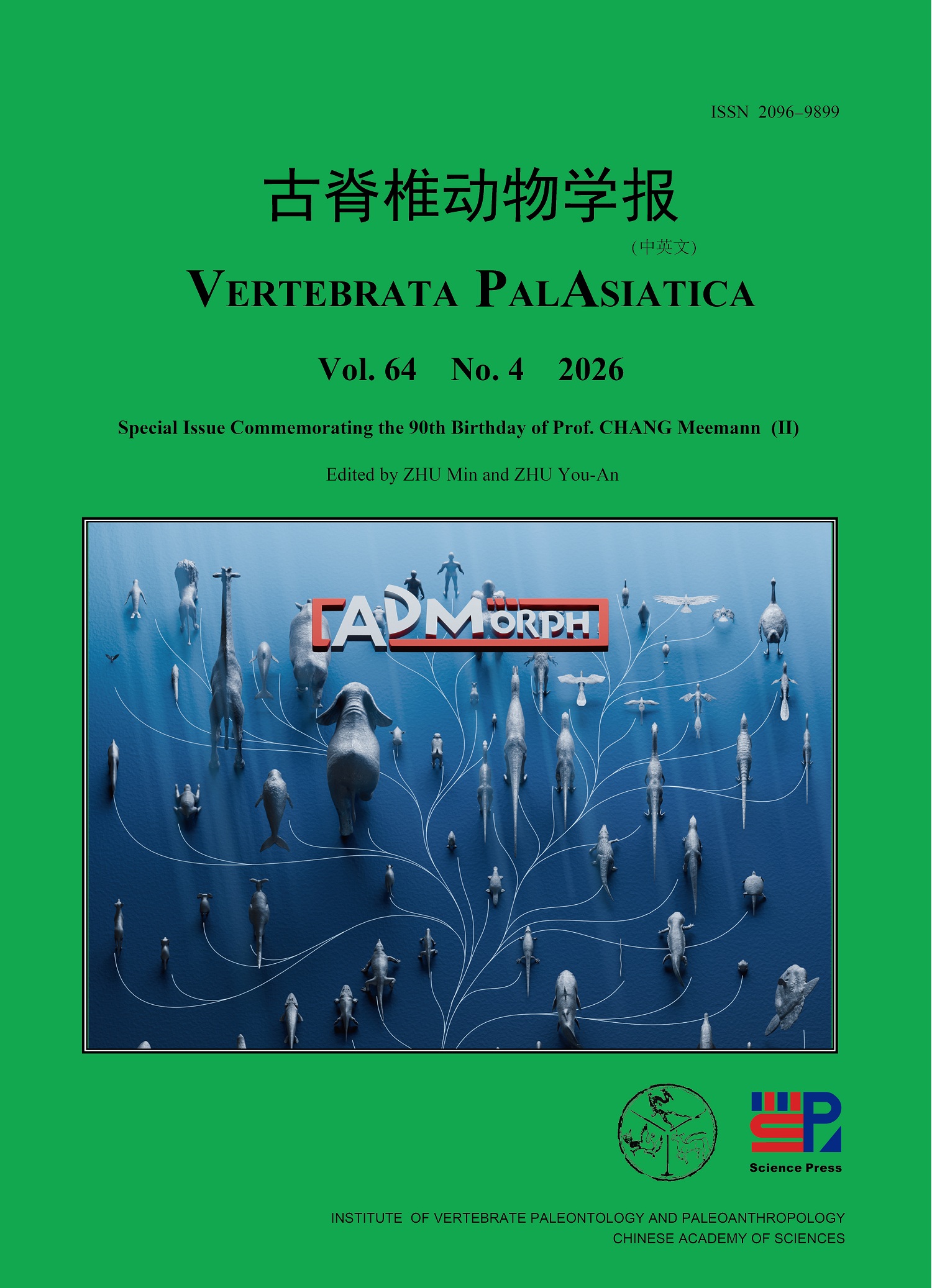
    ADMorph: an open-access 3D morphological database for the study of vertebrate evolution
    YAO Su-Yuan, HOU Ye-Mao, YIN Peng-Fei, ZHANG Xiao-Mei, LIU Xiao-Yue, ZHU Min, LU Jing
    2026, 64(4):  396-409.  DOI: 10.19615/j.cnki.2096-9899.260805
    Asbtract ( )   HTML ( )   PDF (8200KB) ( )  
    Figures and Tables | References | Related Articles | Metrics

    Advances in X-ray computed tomography (CT) and three-dimensional (3D) reconstruction technologies have revolutionized zoological, paleontological, and evolutionary research by enabling non-destructive visualization and quantitative analysis of anatomical structures. Open-access repositories such as MorphoSource have highlighted the growing importance of digital morphology resources. However, access to high-quality, taxonomically comprehensive, and systematically curated 3D datasets remains uneven, particularly for fossil vertebrates and regionally significant biodiversity collections. Here we introduce the Archives of Digital Morphology (ADMorph), an open-access digital repository hosted by the Institute of Vertebrate Paleontology and Paleoanthropology, Chinese Academy of Sciences (IVPP). ADMorph currently archives more than 60000 3D models derived from over 10000 fossil specimens and 4200 extant vertebrate specimens, including approximately 3000 anatomically segmented datasets. ADMorph integrates a large and continuously expanding collection of CT-derived, segmented 3D datasets covering both fossil and extant vertebrates, and provides a centralized platform for their storage, visualization, dissemination, and long-term preservation. The repository archives both raw volumetric CT datasets and derived surface models in standardized formats, supported by structured metadata, searchable records, and interactive visualization tools. ADMorph hosts several specialized anatomically segmented collections, including early vertebrate fossil reconstructions, the digital shark atlas, vertebrate embryological series, and the Yangtze heritage collection of endangered freshwater taxa. The platform also supports community-driven data contributions and curated datasets spanning comparative anatomy, developmental biology, functional morphology, and evolutionary research. By facilitating access to high-quality 3D digital specimens, ADMorph supports a wide range of applications, including virtual paleontology, geometric morphometrics, biomechanical modeling, science education, and public outreach. Collectively, ADMorph improves the global accessibility of vertebrate morphological data, enhances research reproducibility and data sharing, and provides scalable infrastructure for large-scale comparative studies of extant and extinct biodiversity, thereby advancing research on vertebrate evolution across deep time.