
Vertebrata Palasiatica ›› 2026, Vol. 64 ›› Issue (4): 333-347.DOI: 10.19615/j.cnki.2096-9899.260615
FANG Geng-Yu1,2, MU Lin3, JI Cheng3, LI Hang4, YANG Tao4, YANG Shuang4,5, YANG Chen-Guang3, WU Fei-Xiang4,*( )
Received:2026-03-24
Online:2026-10-20
Published:2026-11-05
Contact:
*wufeixiang@ivpp.ac.cn
房庚雨1,2, 牟林3, 季承3, 李航4, 杨涛4, 杨爽4,5, 杨晨光3, 吴飞翔4,*()
基金资助:CLC Number:
FANG Geng-Yu, MU Lin, JI Cheng, LI Hang, YANG Tao, YANG Shuang, YANG Chen-Guang, WU Fei-Xiang. Enigmatic Listracanthus (Chondrichthyes, incertae sedis) from the Lopingian (Permian) of Hunan Province, China. Vertebrata Palasiatica, 2026, 64(4): 333-347.
房庚雨, 牟林, 季承, 李航, 杨涛, 杨爽, 杨晨光, 吴飞翔. 2026, 64(4): 333-347, 湖南二叠纪乐平世棘鳞鲨Listracanthus (软骨鱼类)的发现. 古脊椎动物学报.
Add to citation manager EndNote|Ris|BibTeX
URL: https://www.vertpala.ac.cn/EN/10.19615/j.cnki.2096-9899.260615

Fig. 1 Geographical settings of the localities that yielded Shaoyang Fauna and associated ammonoids of Longtan Formation in Shaoyang, Hunan Province A. map showing the fossil locality of the Shaoyang Fauna; B. outcrop at Zhoujiawa; C-E. associated ammonoids in lateral view: Otocerataceae (Anderssonoceratidae or Araxoceratidae) (C, D), and Pseudogastrioceras sp. (E). Red star indicates the outcrop that yielded listracanthids, black stars indicate other Shaoyang Fauna outcrops. Scale bars equal 5 mm. Map approved number: 湘S(2012)12

Fig. 2 Specimens and enlarged details of Listracanthus shaoyangensis sp. nov. from the Permian (Lopingian) of Shaoyang, Hunan Province A. holotype, IVPP V34643; B, C. paratypes, V34644, V34645; D-H. enlarged details of the specimens, showing the anterior fulcra (D), posterior comb-like processes (E, F), posterior extension of the base (G), and apex (H). White dashed boxes indicate the positions of the enlargements White solid triangles in D and H indicate fulcra, white open triangles in E-H indicate comb-like processes, blue triangles in E indicate lateral ridges, and white arrowhead in F indicates the basal prominence of the comb-like process. Note that all of these structures are preserved as impressions. Scale bars equal 5 mm

Fig. 3 Comparative specimens of other listracanthid species A-D. Listracanthus hystrix (NHMUK PV P62273), showing the complete specimen (A) and enlarged details of the apex (B), middle shaft (C), and root (D); E-G. death assemblage of Acanthorhachis (formerly Listracanthus wardi), preserved as compressed (A. wardi, NHMUK PV P10004) (E), three dimensions (A. spinatus, NHMUK PV P73205a) (F), and in cross section (A. spinatus, NHMUK PV P73207) (G) White solid triangles indicate fulcra, white open triangles indicate comb-like processes, and white arrows with blue fill indicate the cross sections of denticles Scale bars in A, E, and F equal 1 cm; scale bar in G equals 2 mm

Fig. 4 Micro-XRF elemental maps of Listracanthus shaoyangensis sp. nov. from the Permian (Lopingian) of Shaoyang, Hunan Province From left to right: optical image, and elemental maps of silicon (Si), sulfur (S), potassium (K), calcium (Ca), titanium (Ti), vanadium (V), chromium (Cr), and iron (Fe). Scale bars equal 5 mm
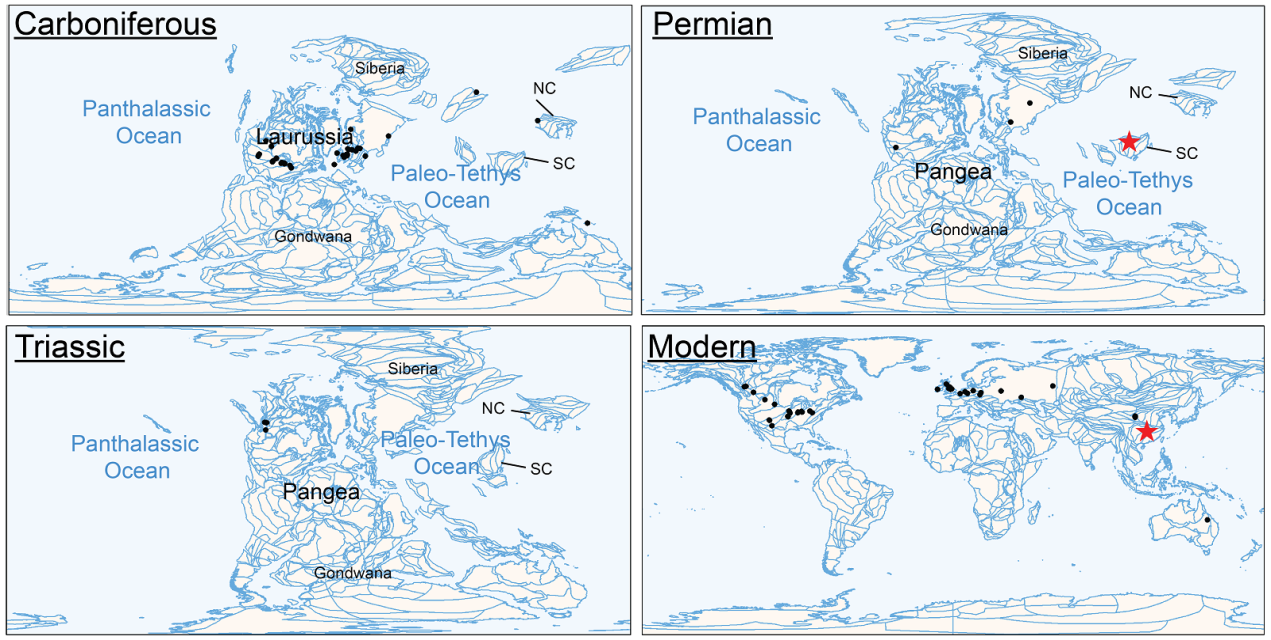
Fig. 5 Paleobiogeographic distribution of listracanthids Reconstructed paleogeographic distribution of fossil localities in the Carboniferous, Permian, Triassic, and distribution of all fossil localities on the modern map The red star indicates the location of the Shaoyang Fauna. NC. North China; SC. South China
| [1] |
Abbott C, Webster M, Angielczyk K, 2023. Ontogenetic mechanisms of size change: implications for the Lilliput effect and beyond. Paleobiology, 50: 1-20
DOI URL |
| [2] | Bao S J, Lin T, Nie H K et al., 2016. Preliminary study of the transitional facies shale gas reservoir characteristics: taking Permian in the Xiangzhong Depression as an example. Earth Sci Front, 23(1): 44-53 |
| [3] | Barnes B D, Sclafani J A, Zaffos A, 2021. Dead clades walking are a pervasive macroevolutionary pattern. Proc Nat Acad Sci, 118: e2019208118 |
| [4] | Benton M J, 2018. Hyperthermal-driven mass extinctions: killing models during the Permian-Triassic mass extinction. Philos Trans R Soc A: Math, Phys Eng Sci, 376: 20170076 |
| [5] |
Benton M J, Wu F X, 2022. Triassic revolution. Front Earth Sci, 10: 899541
DOI URL |
| [6] |
Billè F, Kourousias G, Luchinat E et al., 2016. X-ray fluorescence microscopy artefacts in elemental maps of topologically complex samples: analytical observations, simulation and a map correction method. Spectrochim Acta Part B: Atom Spectrosc, 122: 23-30
DOI URL |
| [7] |
Chung D, Hutchins N, Schultz M P et al., 2021. Predicting the drag of rough surfaces. Ann Rev Fluid Mech, 53: 439-471
DOI URL |
| [8] |
Dal Corso J, Song H J, Callegaro S et al., 2022. Environmental crises at the Permian-Triassic mass extinction. Nat Rev Earth Environ, 3(3): 197-214
DOI |
| [9] | Dankina D, Spiridonov A, Raczyński P et al., 2023. The first late Permian fish fossils from Leszczyna quarry in South-West Poland. Earth Environ Sci Trans R Soc Edinb, 114(1-2): 65-74 |
| [10] |
Dernov V, 2022. Late Bashkirian ammonoids from the Mospyne Formation of the Donets Basin, Ukraine. Fossil Imprint, 78: 489-512
DOI URL |
| [11] | Doyle E, 2025. First Irish record of denticles of the enigmatic Paleozoic shark Listracanthus hystrix from the Carboniferous of County Clare, Ireland. Irish J Earth Sci, 43(1): 45-50 |
| [12] |
Erwin D H, 1994. The Permo-Triassic extinction. Nature, 367: 231-236
DOI |
| [13] |
Ferretti A, Medici L, Savioli M et al., 2021. Dead, fossil or alive: bioapatite diagenesis and fossilization. Palaeogeogr Palaeoclimatol Palaeoecol, 579: 110608
DOI URL |
| [14] |
Fish F E, Lauder G V, 2017. Control surfaces of aquatic vertebrates: active and passive design and function. J Exp Biol, 220: 4351-4363
DOI URL |
| [15] |
Foote M, Crampton J S, Beu A G et al., 2008. On the bidirectional relationship between geographic range and taxonomic duration. Paleobiology, 34(4): 421-433
DOI URL |
| [16] |
Friedman M, Sallan L C, 2012. Five hundred million years of extinction and recovery: a phanerozoic survey of large-scale diversity patterns in fishes. Palaeontology, 55(4): 707-742
DOI URL |
| [17] |
Gayford J H, Engelman R K, Sternes P C et al., 2024. Cautionary tales on the use of proxies to estimate body size and form of extinct animals. Ecol Evol, 14(9): e70218
DOI URL |
| [18] |
Griffin B W, Keating J N, Milla Carmona P S et al., 2026. Evolution of chondrichthyan jaw morphology, from ecological generalists to specialists. Paleobiology, 52(1): 131-144
DOI URL |
| [19] | Gu Z X, Peng Y M, He Y B et al., 2015. Geological conditions of Permian sea-land transitional facies shale gas in the Xiangzhong Depression. Geol China, 42(1): 288-299 |
| [20] |
Guan C G, Wang W, Zhou C M et al., 2017. Controls on fossil pyritization: redox conditions, sedimentary organic matter content, and Chuaria preservation in the Ediacaran Lantian Biota. Palaeogeogr Palaeoclimatol Palaeoecol, 474: 26-35
DOI URL |
| [21] |
Guinot G, Adnet S, Cavin L et al., 2013. Cretaceous stem chondrichthyans survived the end-Permian mass extinction. Nat Commun, 4(1): 2669
DOI |
| [22] |
Ivanov A, 2005. Early Permian chondrichthyans of the Middle and South Urals. Rev Bras Paleontol, 8(2): 127-138
DOI URL |
| [23] | Ivanov A O, Hearst J M, Nestell M K, 2025. Permian chondrichthyans from the Guadalupe Mountains National Park of West Texas (USA). PalZ, doi: 10.1007/s12542-025-00760-x |
| [24] |
Jablonski D, 2002. Survival without recovery after mass extinctions. Proc Nat Acad Sci, 99: 8139-8144
DOI URL |
| [25] |
Jablonski D, 2005. Mass extinctions and macroevolution. Paleobiology, 31(2): 192-210
DOI URL |
| [26] |
Jablonski D, Edie S M, 2025. Mass extinctions and their rebounds: a macroevolutionary framework. Paleobiology, 51(1): 83-96
DOI URL |
| [27] |
Jin Y, Wardlaw B R, Glenister B F et al., 1997. Permian chronostratigraphic subdivisions. Episodes, 20(1): 10-15
DOI URL |
| [28] |
Lauder G V, Drucker E G, 2004. Morphology and experimental hydrodynamics of fish fin control surfaces. IEEE J Ocean Eng, 29(3): 556-571
DOI URL |
| [29] |
Leonova T B, 2018. Permian ammonoid biostratigraphy. Geol Soc, London, Spec Publ, 450(1): 185-203
DOI URL |
| [30] | Lu L W, Fang X S, Ji S A et al., 2002. A contribution to the knowledge of the Namurian in Ningxia. Acta Geosci Sin, 23(2): 165-168 |
| [31] | Lu L W, Zhang Z J, Fang X S, 2005. Notes on the discovery of Listracanthus and Petrodus (Chondrichthyes) from Upper Carboniferous of Ningxia, China. Geol Bull China, 24(6): 499-500 |
| [32] |
Martill D, del Strother P, Gallien F, 2014. Acanthorhachis, a new genus of shark from the Carboniferous (Westphalian) of Yorkshire, England. Geol Mag, 151: 517-533
DOI URL |
| [33] |
Maxwell E E, Romano C, Wu F X et al., 2015. Two new species of Saurichthys (Actinopterygii: Saurichthyidae) from the Middle Triassic of Monte San Giorgio, Switzerland, with implications for character evolution in the genus. Zool J Linn Soc, 173(4): 887-912
DOI URL |
| [34] |
Montañez I P, Poulsen C J, 2013. The Late Paleozoic Ice Age: an evolving paradigm. Annu Rev Earth Planet Sci, 41(1): 629-656
DOI URL |
| [35] | Mutter R J, Neuman A G, 2006. An enigmatic chondrichthyan with Paleozoic affinities from the Lower Triassic of western Canada. Acta Palaeontol Pol, 51(2): 271-282 |
| [36] |
Mutter R J, Neuman A G, 2009. Recovery from the end-Permian extinction event: evidence from “Lilliput Listracanthus”. Palaeogeogr Palaeoclimatol Palaeoecol, 284: 22-28
DOI URL |
| [37] | Newberry J S, Worthen A H, 1870. Descriptions of fossil vertebrates. Geol Palaeontol, Geol Surv Illinois, 4: 343-374 |
| [38] | Romano C, Koot M B, Kogan I et al., 2016. Permian-Triassic Osteichthyes (bony fishes): diversity dynamics and body size evolution. Biol Rev, 91(1): 106-147 |
| [39] |
Saupe E E, Qiao H, Hendricks J R et al., 2015. Niche breadth and geographic range size as determinants of species survival on geological time scales. Global Ecol Biogeogr, 24: 1159-1169
DOI URL |
| [40] |
Schnetz L, Dunne E M, Feichtinger I et al., 2024. Rise and diversification of chondrichthyans in the Paleozoic. Paleobiology, 50(2): 271-284
DOI URL |
| [41] | Schrøder A E, Wielandt D K P, Rasmussen J A et al., 2023. Benchtop micro-X-ray fluorescence, µXRF: an exciting tool for anatomical studies of fossil bony fishes. Lethaia, 56(2): 1-29 |
| [42] |
Shen S Z, Zhang H, Zhang Y C et al., 2019. Permian integrative stratigraphy and timescale of China. Sci China Earth Sci, 62(1): 154-188
DOI |
| [43] |
Smith J C, Sanderson S L, 2013. Particle retention in suspension-feeding fish after removal of filtration structures. Zoology, 116(6): 348-355
DOI PMID |
| [44] |
Twitchett R J, 2007. The Lilliput effect in the aftermath of the end-Permian extinction event. Palaeogeogr Palaeoclimatol Palaeoecol, 252: 132-144
DOI URL |
| [45] |
Van Wassenbergh S, Sanderson S L, 2023. Hydrodynamic analysis of bioinspired vortical cross-step filtration by computational modelling. R Soc Open Sci, 10(5): 230315
DOI URL |
| [46] |
Vázquez P, Clapham M E, 2017. Extinction selectivity among marine fishes during multistressor global change in the end-Permian and end-Triassic crises. Geology, 45(5): 395-398
DOI URL |
| [47] |
Wang F, Finnegan S, Dal Corso J et al., 2025. Brachiopods and forams reduced calcification costs through morphological simplification during mass extinction events. Nat Ecol Evol, 9(8): 1456-1468
DOI |
| [48] | Wu Z R, He S, He X P et al., 2019. Pore structure characteristics and comparisons of Upper Permian Longtan and Dalong Formation transitional facies shale in Xiangzhong-Lianyuan Depression. Earth Sci, 44: 3757-3772 |
| [1] | Zhijie Jack TSENG, WANG Xiao-Ming. Late Miocene immigrant carnivorans in California, USA highlight a coastal corridor for intercontinental dispersals . Vertebrata Palasiatica, 2025, 63(4): 266-276. |
| [2] | LUO Yan-Chao, ZHU Min, LU Li-Wu, PAN Zhao-Hui. Reappraisal of Bothriolepis sinensis Chi, 1940 from the Tiaomachien Formation, Hunan, China . Vertebrata Palasiatica, 2023, 61(4): 261-276. |
| [3] | XU Guang-Hui. A new species of Luganoia (Luganoiidae, Neopterygii) from the Middle Triassic Xingyi Biota, Guizhou, China . Vertebrata Palasiatica, 2020, 58(4): 267-282. |
| [4] | ZHU Min, WANG Jun-Qing, WANG Shi-Tao. A NEW ANTARCTASPID ARTHRODIRE (PLACODERM FISH) FROM THE LOWER DEVONIAN OF GUANGXI, CHINA . Vertebrata Palasiatica, 2010, 48(2): 101-110. |
| Viewed | ||||||
|
Full text |
|
|||||
|
Abstract |
|
|||||
