
Vertebrata Palasiatica ›› 2026, Vol. 64 ›› Issue (1): 1-25.DOI: 10.19615/j.cnki.2096-9899.251117
QIU Zhu-Ding1( ), Lawrence J. FLYNN2, WANG Ban-Yue1, LI Lu1
Received:2025-07-26
Online:2026-01-20
Published:2025-12-30
Contact:
qiuzhuding@ivpp.ac.cn
邱铸鼎1(), 王伴月1, 李录1
基金资助:CLC Number:
QIU Zhu-Ding, Lawrence J. FLYNN, WANG Ban-Yue, LI Lu. Cricetids (Rodentia, Mammalia) from the Late Miocene Yihachi locality of Gansu, China. Vertebrata Palasiatica, 2026, 64(1): 1-25.
邱铸鼎, 王伴月, 李录. 2026, 64(1): 1-25, 甘肃晚中新世伊哈池地点的仓鼠化石. 古脊椎动物学报.
Add to citation manager EndNote|Ris|BibTeX
URL: https://www.vertpala.ac.cn/EN/10.19615/j.cnki.2096-9899.251117
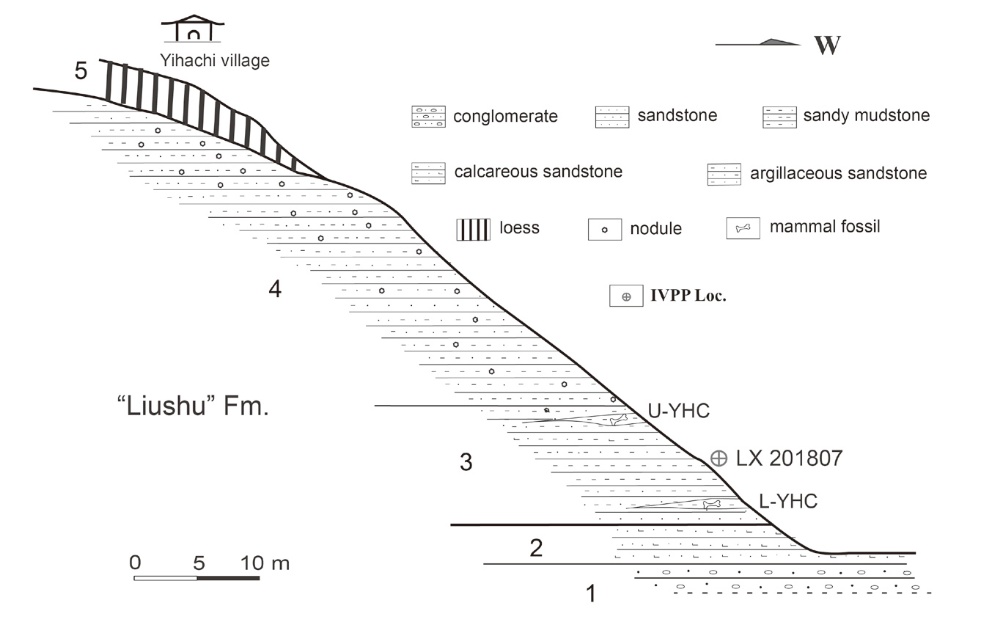
Fig. 1 Section of the fossil locality Yihachi
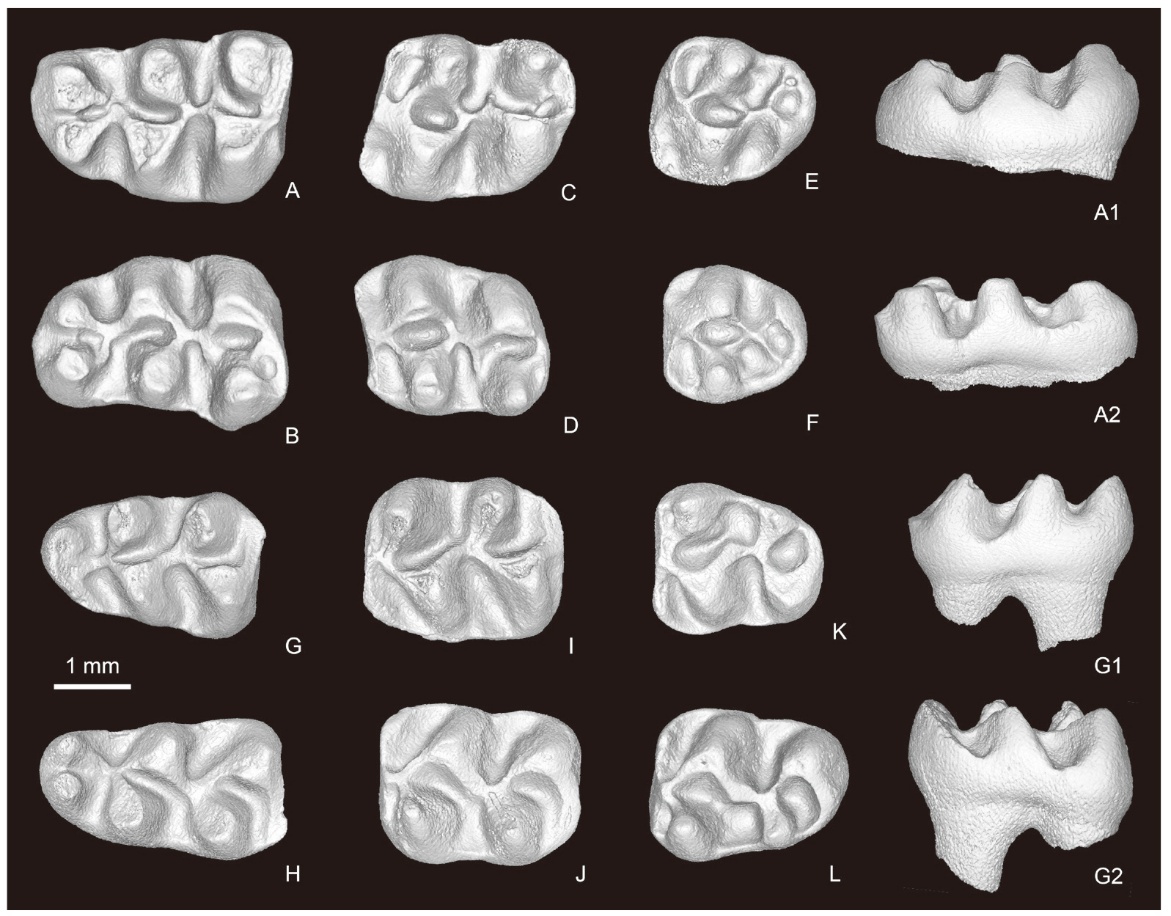
Fig. 2 Molars of Nannocricetus primitivus from Yihachi, Gansu A. l M1 (IVPP V34185.376); B. r M1 (V34185.1); C. l M2 (V34185.377); D. r M2 (V34185.2); E. l M3 (V34185.378); F. r M3 (V34185.3); G. l m1 (V34185.379); H. r m1 (V34185.4); I. l m2 (V34185.380); J. r m2 (V34185.5); K. l m3 (V34185.381); L. r m3 (V34185.6) A-L. occlusal views; A1, G1. lingual views; A2, G2. buccal views
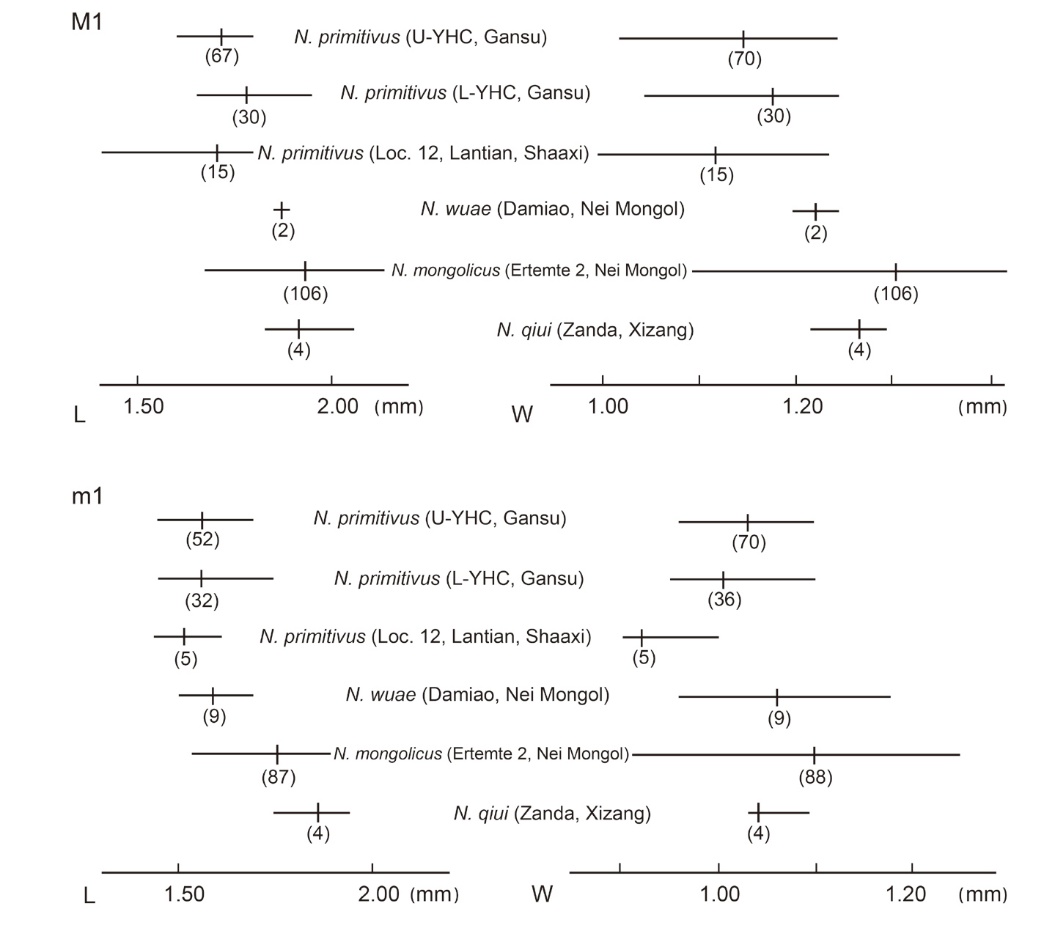
Fig. 3 Size ranges and averages of length and width in the first molars of various species of Nannocricetus from Yihachi, Gansu and other localities in China Measurements of Lantian N. primitivus, N. wuae, Ertemte N. mongolicus and N. qiui are cited from Zhang et al., 2008, 2011; Wu, 1991, and Li et al., 2018, respectively Numbers inside the parentheses are specimen numbers
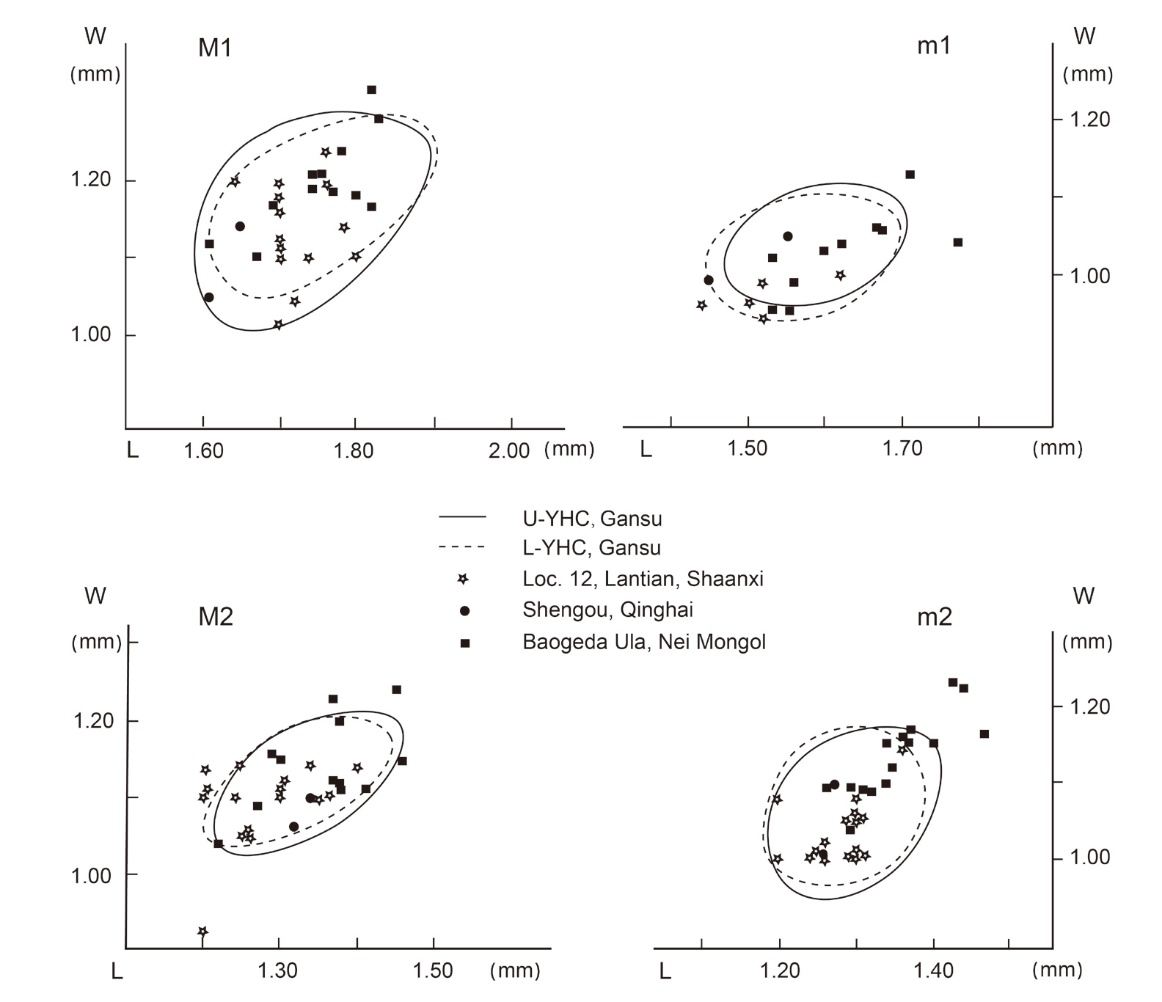
Fig. 4 Scatter diagrams showing the length and width of the first two molars of Nannocricetus primitivus from Yihachi, Gansu and some other localities in northern China Measurements of specimens from Lantian, Shengou and Baogeda Ula are cited from Zhang et al., 2008, Qiu and Li, 2008, 2016
| Tooth | Length | Width | |||||
|---|---|---|---|---|---|---|---|
| N | Range | Average | N | Range | Average | ||
| U-YHC (upper lens) | |||||||
| M1 | 67 | 1.60‒1.90 | 1.71 | 70 | 1.02‒1.25 | 1.15 | |
| M2 | 63 | 1.22‒1.45 | 1.33 | 64 | 1.02‒1.20 | 1.11 | |
| M3 | 52 | 0.90‒1.15 | 1.03 | 52 | 0.90‒1.15 | 1.01 | |
| m1 | 52 | 1.45‒1.70 | 1.59 | 51 | 0.95‒1.10 | 1.03 | |
| m2 | 66 | 1.20‒1.40 | 1.30 | 65 | 0.95‒1.15 | 1.07 | |
| m3 | 60 | 1.10‒1.35 | 1.21 | 60 | 0.85‒1.10 | 0.98 | |
| L-YHC (lower lens) | |||||||
| M1 | 30 | 1.65‒1.95 | 1.78 | 30 | 1.05‒1.25 | 1.18 | |
| M2 | 35 | 1.20‒1.45 | 1.34 | 35 | 1.05‒1.20 | 1.13 | |
| M3 | 14 | 0.92‒1.05 | 1.00 | 14 | 0.92‒1.05 | 1.00 | |
| m1 | 32 | 1.45‒1.70 | 1.56 | 36 | 0.95‒1.10 | 1.01 | |
| m2 | 43 | 1.15‒1.35 | 1.28 | 42 | 1.00‒1.16 | 1.07 | |
| m3 | 21 | 1.05‒1.27 | 1.19 | 21 | 0.90‒1.05 | 0.98 | |
Table 1 Measurements of molars of Nannocricetus primitivus from Yihachi, Gansu (mm)
| Tooth | Length | Width | |||||
|---|---|---|---|---|---|---|---|
| N | Range | Average | N | Range | Average | ||
| U-YHC (upper lens) | |||||||
| M1 | 67 | 1.60‒1.90 | 1.71 | 70 | 1.02‒1.25 | 1.15 | |
| M2 | 63 | 1.22‒1.45 | 1.33 | 64 | 1.02‒1.20 | 1.11 | |
| M3 | 52 | 0.90‒1.15 | 1.03 | 52 | 0.90‒1.15 | 1.01 | |
| m1 | 52 | 1.45‒1.70 | 1.59 | 51 | 0.95‒1.10 | 1.03 | |
| m2 | 66 | 1.20‒1.40 | 1.30 | 65 | 0.95‒1.15 | 1.07 | |
| m3 | 60 | 1.10‒1.35 | 1.21 | 60 | 0.85‒1.10 | 0.98 | |
| L-YHC (lower lens) | |||||||
| M1 | 30 | 1.65‒1.95 | 1.78 | 30 | 1.05‒1.25 | 1.18 | |
| M2 | 35 | 1.20‒1.45 | 1.34 | 35 | 1.05‒1.20 | 1.13 | |
| M3 | 14 | 0.92‒1.05 | 1.00 | 14 | 0.92‒1.05 | 1.00 | |
| m1 | 32 | 1.45‒1.70 | 1.56 | 36 | 0.95‒1.10 | 1.01 | |
| m2 | 43 | 1.15‒1.35 | 1.28 | 42 | 1.00‒1.16 | 1.07 | |
| m3 | 21 | 1.05‒1.27 | 1.19 | 21 | 0.90‒1.05 | 0.98 | |
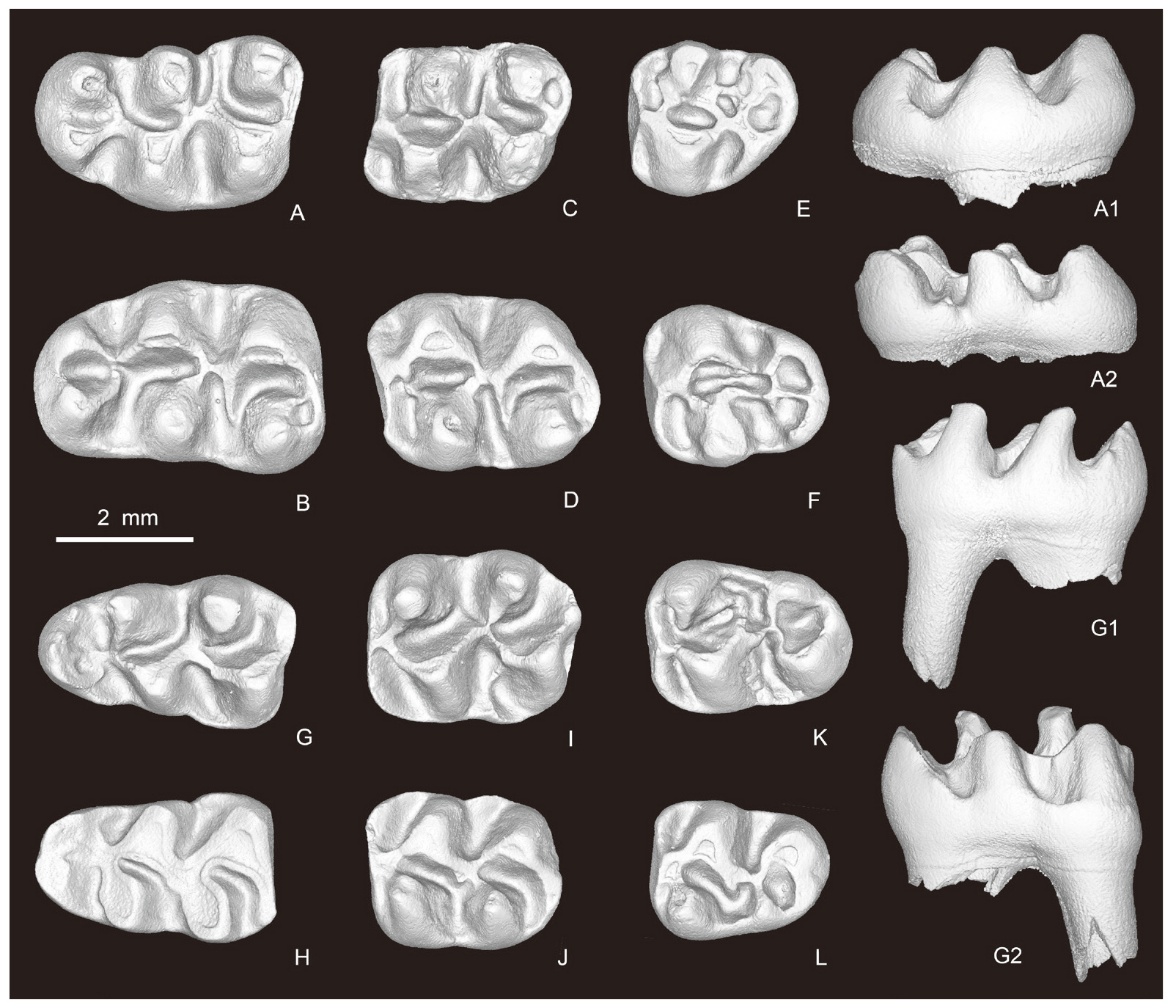
Fig. 5 Molars of Sinocricetus primus sp. nov. from Yihachi, Gansu A. l M1 (IVPP V34186, holotype); B. r M1 (V34188.1); C. l M2 (V34187.1); D. r M2 (V34188.2); E. l M3 (V34187.2); F. r M3 (V34188.3); G. l m1 (V34188.4); H. r m1 (V34187.3); I. l m2 (V34188.5); J. r m2 (V34187.4); K. l m3 (V34188.6); L. r m3 (V34187.5) A-L. occlusal views; A1, G1. lingual views; A2, G2. buccal views
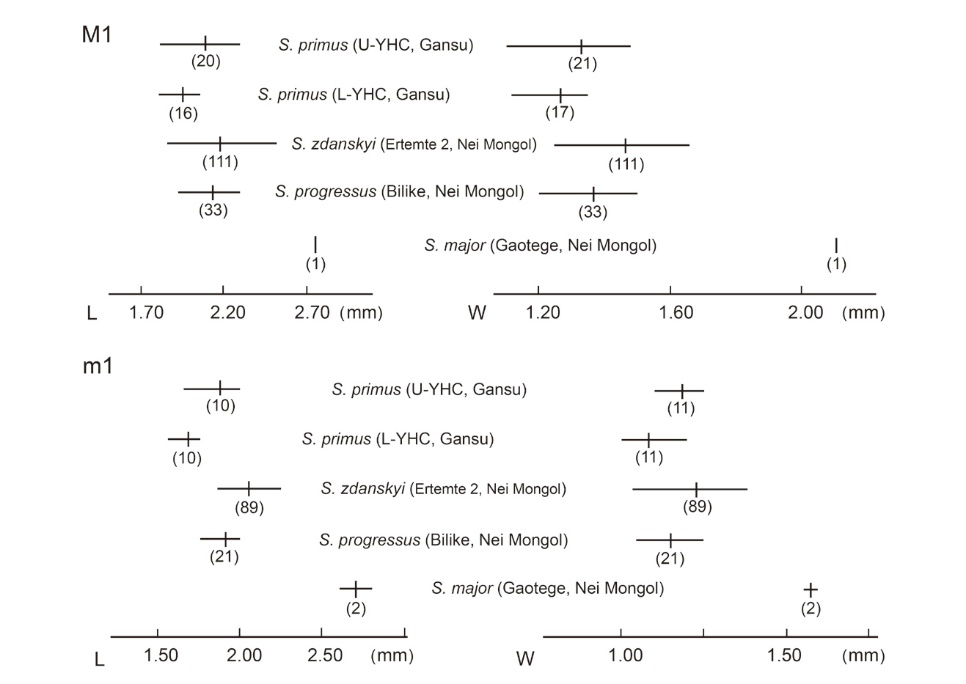
Fig. 6 Size ranges and averages of length and width in the first molars of Sinocricetus primus sp. nov. from Yihachi, Gansu and other species of the genus in China Measurements of S. zdanskyi from Ertemte, S. progressus from Bilike, and S. major from Gaotege are cited from Wu, 1991; Qiu and Storch, 2000; Li, 2010, respectively Numbers inside the parentheses are specimen numbers
| Tooth | Length | Width | |||||
|---|---|---|---|---|---|---|---|
| N | Range | Average | N | Range | Average | ||
| U-YHC (upper lens) | |||||||
| M1 | 20 | 1.80‒2.30 | 2.09 | 21 | 1.10‒1.48 | 1.33 | |
| M2 | 19 | 1.35‒1.85 | 1.59 | 19 | 1.15‒1.40 | 1.31 | |
| M3 | 18 | 1.15‒1.55 | 1.39 | 18 | 1.05‒1.35 | 1.24 | |
| m1 | 10 | 1.65‒2.00 | 1.89 | 11 | 1.10‒1.25 | 1.19 | |
| m2 | 17 | 1.40‒1.65 | 1.57 | 16 | 1.05‒1.40 | 1.27 | |
| m3 | 12 | 1.20‒1.90 | 1.55 | 12 | 1.00‒1.30 | 1.17 | |
| L-YHC (lower lens) | |||||||
| M1 | 16 | 1.80‒2.05 | 1.93 | 17 | 1.12‒1.35 | 1.27 | |
| M2 | 12 | 1.34‒1.65 | 1.47 | 12 | 1.15‒1.36 | 1.25 | |
| M3 | 14 | 0.92‒1.05 | 1.00 | 14 | 0.92‒1.05 | 1.00 | |
| m1 | 10 | 1.56‒1.75 | 1.69 | 11 | 1.00‒1.20 | 1.08 | |
| m2 | 15 | 1.32‒1.55 | 1.44 | 15 | 1.05‒1.30 | 1.18 | |
| m3 | 10 | 1.32‒1.55 | 1.43 | 10 | 0.97‒1.40 | 1.12 | |
Table 2 Measurements of molars of Sinocricetus primus sp. nov. from Yihachi, Gansu (mm)
| Tooth | Length | Width | |||||
|---|---|---|---|---|---|---|---|
| N | Range | Average | N | Range | Average | ||
| U-YHC (upper lens) | |||||||
| M1 | 20 | 1.80‒2.30 | 2.09 | 21 | 1.10‒1.48 | 1.33 | |
| M2 | 19 | 1.35‒1.85 | 1.59 | 19 | 1.15‒1.40 | 1.31 | |
| M3 | 18 | 1.15‒1.55 | 1.39 | 18 | 1.05‒1.35 | 1.24 | |
| m1 | 10 | 1.65‒2.00 | 1.89 | 11 | 1.10‒1.25 | 1.19 | |
| m2 | 17 | 1.40‒1.65 | 1.57 | 16 | 1.05‒1.40 | 1.27 | |
| m3 | 12 | 1.20‒1.90 | 1.55 | 12 | 1.00‒1.30 | 1.17 | |
| L-YHC (lower lens) | |||||||
| M1 | 16 | 1.80‒2.05 | 1.93 | 17 | 1.12‒1.35 | 1.27 | |
| M2 | 12 | 1.34‒1.65 | 1.47 | 12 | 1.15‒1.36 | 1.25 | |
| M3 | 14 | 0.92‒1.05 | 1.00 | 14 | 0.92‒1.05 | 1.00 | |
| m1 | 10 | 1.56‒1.75 | 1.69 | 11 | 1.00‒1.20 | 1.08 | |
| m2 | 15 | 1.32‒1.55 | 1.44 | 15 | 1.05‒1.30 | 1.18 | |
| m3 | 10 | 1.32‒1.55 | 1.43 | 10 | 0.97‒1.40 | 1.12 | |
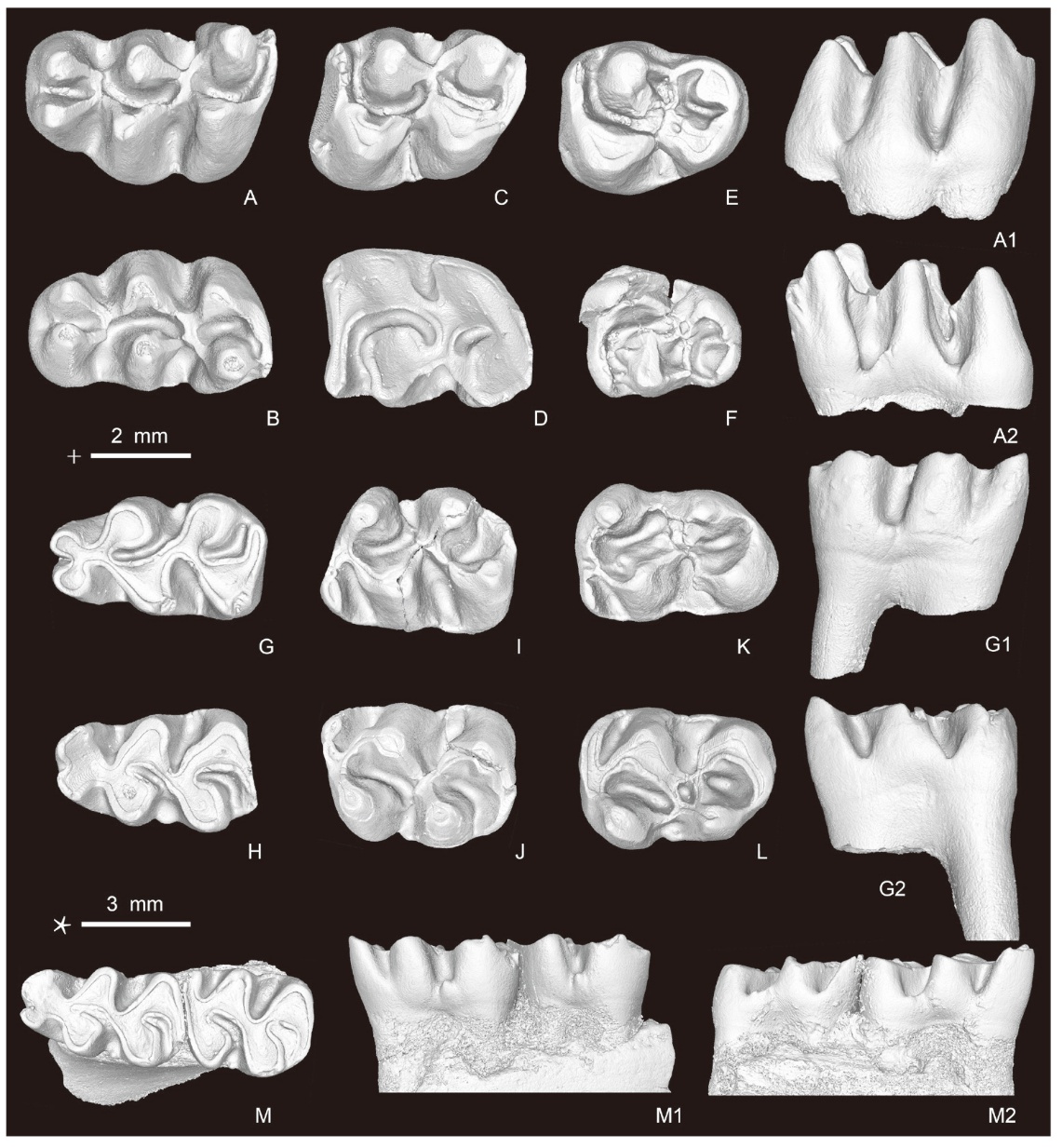
Fig. 7 Molars of Mesocricetus fengi sp. nov. from Yihachi, Gansu A. l M1 (IVPP V34189, holotype); B. r M1 (V34190.2); C. l M2 (V34190.3); D. l M2 (V34191.1, reversed); E. l M3 (V34190.4); F. r M3 (V34190.5); G. l m1 (V34190.6); H. r m1 (V34190.7); I. l m2 (V34190.8); J. r m2 (V34190.9); K. l m3 (V34190.10); L. r m3 (V34190.11), M. right mandibular fragment with m1-2 (V34190.1) A-M. occlusal views; A1, G1, M1. lingual views; A2, G2, M2. buccal views. Scale bars: + for A-L, * for M
| Tooth | Length | Width | |||||
|---|---|---|---|---|---|---|---|
| N | Range | Average | N | Range | Average | ||
| U-YHC (upper lens) | |||||||
| M1 | 4 | 2.40‒2.70 | 2.58 | 5 | 1.50‒1.75 | 1.63 | |
| M2 | 5 | 2.10‒2.25 | 2. 15 | 5 | 1.55‒1.65 | 1.62 | |
| M3 | 3 | 1.70‒1.76 | 1.74 | 4 | 1.33‒1.55 | 1.45 | |
| m1 | 7 | 2.05‒2.30 | 2.18 | 9 | 1.35‒1.45 | 1.41 | |
| m2 | 7 | 1.85‒2.00 | 1.95 | 7 | 1.40‒1.65 | 1.50 | |
| m3 | 9 | 1.70‒2.06 | 1.94 | 7 | 1.20‒1.50 | 1.38 | |
| L-YHC (lower lens) | |||||||
| M2 | 2 | 1.95‒2.00 | 1.98 | 2 | 1.50‒1.60 | 1.55 | |
Table 3 Measurements of molars of Mesocricetus fengi sp. nov. from Yihachi, Gansu (mm)
| Tooth | Length | Width | |||||
|---|---|---|---|---|---|---|---|
| N | Range | Average | N | Range | Average | ||
| U-YHC (upper lens) | |||||||
| M1 | 4 | 2.40‒2.70 | 2.58 | 5 | 1.50‒1.75 | 1.63 | |
| M2 | 5 | 2.10‒2.25 | 2. 15 | 5 | 1.55‒1.65 | 1.62 | |
| M3 | 3 | 1.70‒1.76 | 1.74 | 4 | 1.33‒1.55 | 1.45 | |
| m1 | 7 | 2.05‒2.30 | 2.18 | 9 | 1.35‒1.45 | 1.41 | |
| m2 | 7 | 1.85‒2.00 | 1.95 | 7 | 1.40‒1.65 | 1.50 | |
| m3 | 9 | 1.70‒2.06 | 1.94 | 7 | 1.20‒1.50 | 1.38 | |
| L-YHC (lower lens) | |||||||
| M2 | 2 | 1.95‒2.00 | 1.98 | 2 | 1.50‒1.60 | 1.55 | |
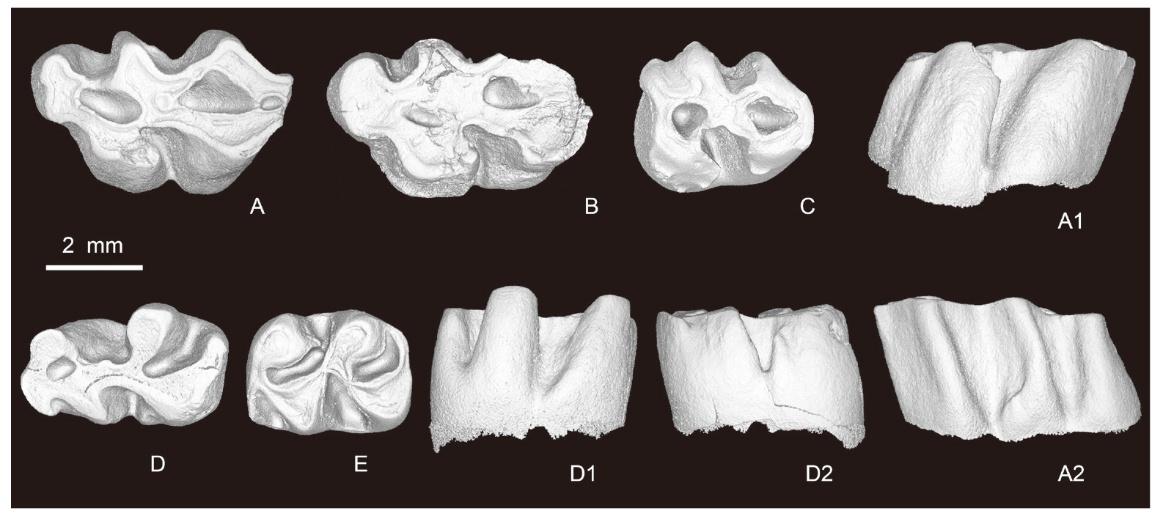
Fig. 8 Molars of Rhinocerodon linxiamys sp. nov. from Yihachi, Gansu A. r M1 (IVPP V34192, holotype, reversed); B. r M1 (V34193.1, reversed); C. l M3 (V34194.1); D. l m1 (V34193.2); E. l m2 (V34194.2). A-E. occlusal views; A1, D1. lingual views; A2, D2. buccal views
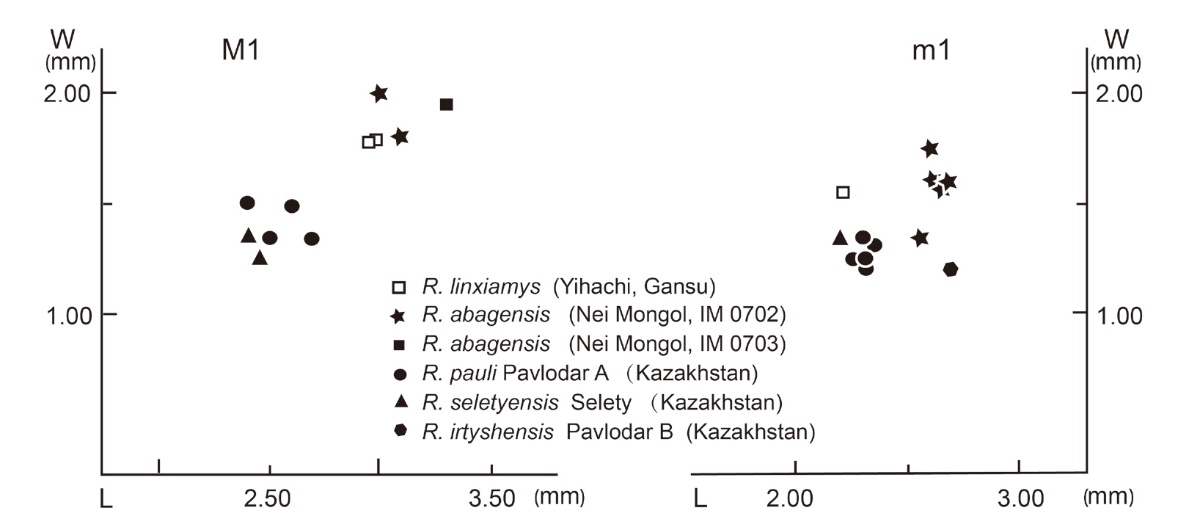
Fig. 9 Scatter diagrams showing length and width in the first molars of Rhinocerodon from Yihachi, Gansu and other species of the genus from Kazakhstan and Nei Mongol Measurements of the specimens of the Kazakhstan species are cited from Zazhigin, 2003
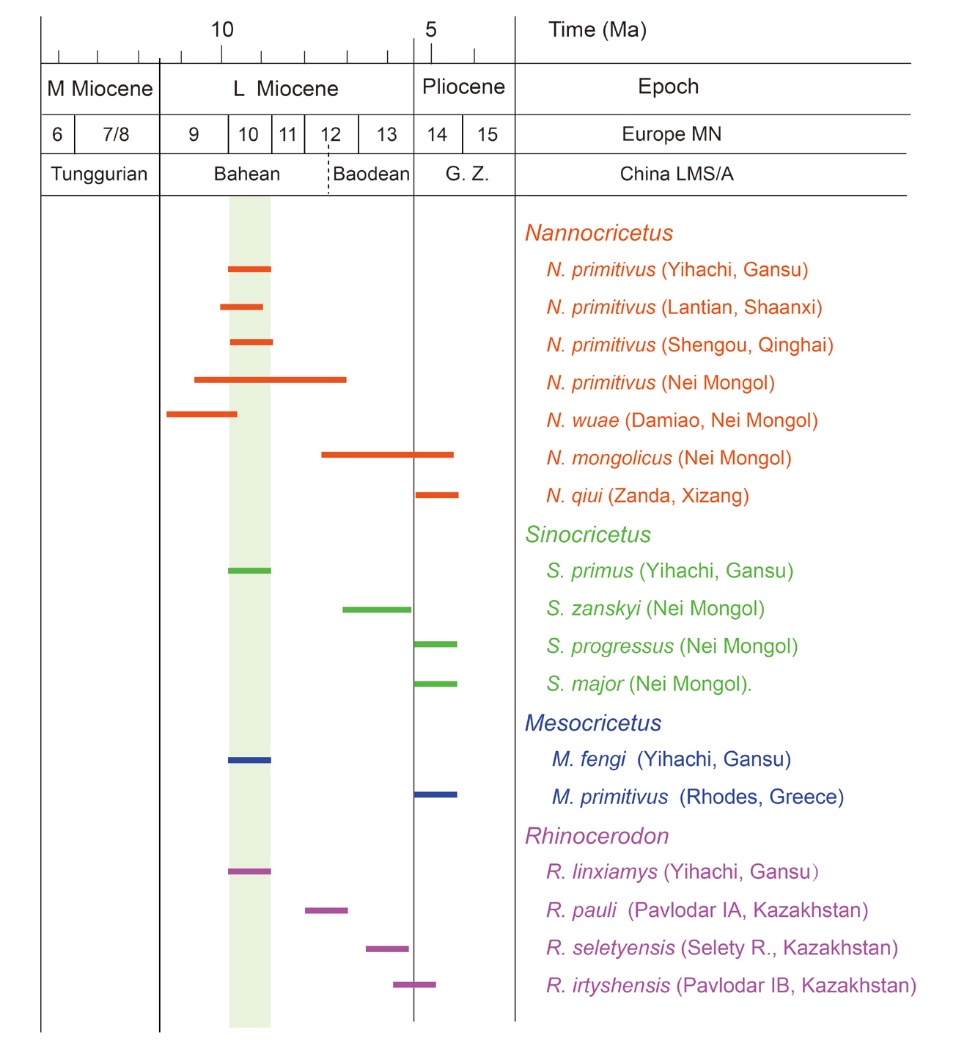
Fig. 10 Biostratigraphic ranges of various species of the cricetid genera present in the Yihachi Fauna G. Z. in the China LMS/A column indicates Gaozhuangian; Shading indicates the proposed ages of Yihachi cricetid composition
| [1] |
An Z, John E K, Warren L P et al., 2001. Evolution of Asian monsoons and phased uplift of the Himalaya-Tibetan plateau since Late Miocene times. Nature, 411: 62-66
DOI |
| [2] | de Bruijn H, Dawson M R, Mein P, 1970. Upper Pliocene Rodentia, Lagomorpha and Insectivora (Mammalia) from the isle of Rhodes (Greece). Proc K Ned Akad Wet, Ser B, 73(5): 552-567 |
| [3] |
Kaakinen A, Aziz H A, Passey B H et al., 2015. Age and stratigraphic context of Pliopithecus and associated fauna from Miocene sedimentary strata at Damiao, Inner Mongolia, China. J Asian Earth Sci, 100: 78-90
DOI URL |
| [4] | Li Q, 2010. Note on the cricetids from the Pliocene Gaotege locality, Nei Mongol. Vert PalAsiat, 48(3): 247-261 |
| [5] |
Li Q, Xie G P, Takeuchi G T et al., 2014. Vertebrate fossils on the roof of the world: biostratigraphy and geochronology of high-elevation Kunlun Pass Basin, northern Tibetan Plateau, and basin history as related to the Kunlun strike-slip fault. Palaeogeogr Palaeoclimatol Palaeoecol, 411: 46-55
DOI URL |
| [6] | Li Q, Stidham T A, Ni X J et al., 2018. Two new Pliocene hamsters (Cricetidae, Rodentia) from southwestern Tibet (China), and their implications for rodent dispersal ‘into Tibet’. J Vert Paleont, doi: 10.1080/02724634.2017.1403443 |
| [7] |
Liu T S, Ding M L, Derbyshire E, 1996. Gravel deposits on the margins of the Qinghai-Xizang Plateau, and their environmental significance. Paleogeogr Palaeoclimatol Palaeoecol, 120: 159-170
DOI URL |
| [8] | Maridet O, Daxner-Höck G, Badamgarav D et al., 2014. Cricetidae (Rodentia, Mammalia) from the Valley of Lakes (Central Mongolia): focus on the Miocene record. Ann Nat Mus Wien, 116: 247-269 |
| [9] | Qiu Z D, Li L, 2023. Miocene squirrels from Linxia Basin, Gansu, China: paleoenvironmental and palaeoecological implications. Palaeogeogr Palaeoclimatol Palaeoecol, 619: 1-14 |
| [10] | Qiu Z D, Li Q, 2008. Late Miocene micromammals from the Qaidam Basin in the Qinghai-Xizang Plateau. Vert PalAsiat, 46(4): 284-306 |
| [11] | Qiu Z D, Li Q, 2016. Neogene rodents from central Nei Mongol, China. Palaeontol Sin, New Ser C, 30: 1-684 |
| [12] | Qiu Z D, Storch G, 2000. The Early Pliocene micromammalian fauna of Bilike, Inner Mongolia, China (Mammalia: Lipotyphla, Chiroptera, Rodentia, Lagomorpha). Senckenbergiana lethaea, 80: 173-229 |
| [13] | Qiu Z D, Wang B Y, Li L, 2023. Middle Cenozoic micromammals from Linxia Basin, Gansu Province, China, and their implications for biostratigraphy and palaeoecology. Palaeogeogr Palaeoclimatol Palaeoecol, 616: 1-17 |
| [14] | Schaub S, 1930. Quartare und jungteriare Hamster. Abh Schweiz Paläont Gesell, 49: 1-49 |
| [15] | Schaub S, 1934. Über einige fossile Simplicidentaten aus China und der Mongolei. Abh Schweiz Paläont Gesell, 54: 1-40 |
| [16] |
Strömberg C A E, 2011. Evolution of grassland ecosystems. Ann Rev Earth Planet Sci, 39: 517-544
DOI URL |
| [17] | Wang B Y, Wu W Y, Qiu Z D, 2020. Family Cricetidae Fischer von Waldheim, 1817. In: In: Qiu Z D, Li C K, Zheng S H eds. Palaeovertebrata Sinica, Vol. III, Fasc 5(2). Beijing: Science Press. 10-152 |
| [18] | Wang P X, 1998. Deformtion of Asia and global cooling: searching links between climate and tectonics. Quat Sci, 3: 213-221 |
| [19] | Wu W Y, 1991. The Neogene mammalian faunas of Ertemte and Harr Obo in Inner Mongolia (Nei Mongol), China. 9. Hamster: Cricetinae (Rodentia). Senckenbergiana lethaea, 71: 257-305 |
| [20] |
Zazhigin V S, 2003. New genus of Cricetodontinae (Rodentia: Cricetidae) from the Late Miocene of Kazakhstan. Russ J Theriol, 2(2): 65-69
DOI URL |
| [21] | Zhang Z Q, Zheng S H, Li L P, 2008. Late Miocene cricetids from the Bahe Formation, Shaanxi Province. Vert PalAsiat, 46(4): 307-316 |
| [22] | Zhang Z Q, Wang L H, Liu Y et al., 2011. A new species of Late Miocene hamster (Cricetidae, Rodentia) from Damiao, Nei Mongol. Vert PalAsiat, 49(2): 201-209 |
| [23] | Zheng S H, Zhang Z Q, 2001. Late Miocene-Early Pleistocene biostratigraphy of the Leijiahe area, Lingtai, Gansu. Vert PalAsiat, 39(2): 215-228 |
| [1] | Muhammad ILYAS, LI Qiang, SHI Qin-Qin, NI Xi-Jun. The Late Miocene ‘ovibovin’ bovids in Eurasia . Vertebrata Palasiatica, 2024, 62(4): 262-290. |
| [2] | Anek R. SANKHYAN, Olivier CHAVASSEAU. New suoid remains (Mammalia, Artiodactyla) from the Late Miocene of Haritalyangar, India . Vertebrata Palasiatica, 2024, 62(1): 69-84. |
| [3] | Lawrence J. FLYNN, LI Qiang, Jay KELLEY, Nina G. JABLONSKI, JI Xue-Ping, Denise F. SU, WANG Xiao-Ming. A giant bamboo rat from the latest Miocene of Yunnan . Vertebrata Palasiatica, 2023, 61(4): 277-283. |
| [4] | WANG Ban-Yue. A new species of Pararhizomys (Tachyoryctoidinae, Muroidea) from Linxia Basin of Gansu Province . Vertebrata Palasiatica, 2022, 60(4): 271-277. |
| [5] | Henry GALIANO, Z. Jack TSENG, Nikos SOLOUNIAS, WANG Xiao-Ming, QIU Zhan-Xiang, Stuart C. WHITE. A new aardwolf-line fossil hyena from Middle and Late Miocene deposits of Linxia Basin, Gansu, China . Vertebrata Palasiatica, 2022, 60(2): 81-116. |
| [6] | ZHANG Xiao-Xiao, SUN Dan-Hui. A cuboid bone of a large Late Miocene elasmothere from Qingyang, Gansu, and its morphological significance . Vertebrata Palasiatica, 2022, 60(1): 29-41. |
| [7] | WANG Shi-Qi, LI Chun-Xiao, ZHANG Xiao-Xiao. On the scientific names of mastodont taxa: nomenclature, Chinese translation, and taxonomic problems . Vertebrata Palasiatica, 2021, 59(4): 295-332. |
| [8] | Chiara ANGELONE, ZHANG Zhao-Qun. Climate change and evolution of early lagomorphs (Mammalia): a study perspective based on new materials of Ordolagus from Nei Mongol (northern China) . Vertebrata Palasiatica, 2021, 59(2): 138-168. |
| [9] | WANG Qian, LIU Yan, WANG Li-Hua, Mikael FORTELIUS, ZHANG Zhao-Qun. An Upper Miocene “Hipparion fauna” locality sandwiched by basalt in Hanjiaying, Nei Mongol . Vertebrata Palasiatica, 2021, 59(2): 125-137. |
| [10] | ZHANG Li-Min, DONG Wei, NI Xi-Jun, LI Qiang. Late Miocene micromammalian assemblage of Tuchengzi and its biochronological position in Neogene faunal sequence in central Nei Mongol, China . Vertebrata Palasiatica, 2021, 59(1): 45-63. |
| [11] | WANG Ban-Yue, QIU Zhan-Xiang. New Hystrix (Hystricidae, Rodentia) from the Neogene of Linxia Basin, Gansu, China . Vertebrata Palasiatica, 2020, 58(3): 204-220. |
| [12] | WANG Ban-Yue, QIU Zhan-Xiang, LI Lü-Zhou. A Late Miocene Huerzelerimys (Rodentia: Muridae) skull from Hezheng, Gansu, China . Vertebrata Palasiatica, 2020, 58(2): 120-133. |
| [13] | XIONG Wu-Yang. Basicranial morphology of Late Miocene Dinocrocuta gigantea (Carnivora: Hyaenidae) from Fugu, Shaanxi . Vertebrata Palasiatica, 2019, 57(4): 274-307. |
| [14] | LIU Yu-Hai, ZHU Min, LIN Xiang-Hong, LU Li-Wu, GAI Zhi-Kun. A reappraisal of the Silurian galeaspids (stem-Gnathostomata) from Tarim Basin, Xinjiang . Vertebrata Palasiatica, 2019, 57(4): 253-273. |
| [15] | WANG Min, Jingmai O’CONNOR, ZHOU Zhong-He. A taxonomical revision of the Confuciusornithiformes (Aves: Pygostylia) . Vertebrata Palasiatica, 2019, 57(1): 1-37. |
| Viewed | ||||||
|
Full text |
|
|||||
|
Abstract |
|
|||||
