
古脊椎动物学报 ›› 2026, Vol. 64 ›› Issue (4): 372-395.DOI: 10.19615/j.cnki.2096-9899.260814CSTR: 32090.14.j.cnki.2096-9899.260814
董丽萍1, 李杰2, 常飞2, 韩晔2, 刘迪2, 王原1
收稿日期:2026-05-19
出版日期:2026-10-20
发布日期:2026-11-05
基金资助:DONG Li-Ping1, LI Jie2, CHANG Fei2, HAN Ye2, LIU Di2, WANG Yuan1
Received:2026-05-19
Published:2026-10-20
Online:2026-11-05
摘要:
多凿齿蜥类是一类繁盛于晚白垩世的有鳞类,广泛分布于亚洲、北美洲以及其他地区,在属种、形态和生态上都表现出高度多样性。虽然多凿齿蜥类以拥有众多大型植食性代表而闻名,但它的主要化石地点也产出了不少小型食虫物种,中国河南上白垩统秋扒组的栾川伏牛蜥(Funiusaurus luanchuanensis)就是其中之一。伏牛蜥之前仅有一个虽近完整但较为破碎的头骨,因此提供的形态学信息有限。基于一件新发现于河南栾川的完整头骨的高精度CT数据和其他几件头骨和头后骨骼标本,补充了伏牛蜥的大量解剖学数据,尤其是腭区、脑颅、脊柱以及四肢部分。这些新数据将有助于建立一个更完善的多凿齿蜥类形态矩阵,从而深入讨论多凿齿蜥类的体型大小和食性转变等演化历史。
中图分类号:
董丽萍, 李杰, 常飞, 韩晔, 刘迪, 王原. 栾川伏牛蜥(有鳞类,多凿齿蜥类)新材料的形态学研究. 古脊椎动物学报, 2026, 64(4): 372-395.
DONG Li-Ping, LI Jie, CHANG Fei, HAN Ye, LIU Di, WANG Yuan. Morphology of Funiusaurus luanchuanensis (Squamata, Polyglyphanodontia) based on new material. Vertebrata Palasiatica, 2026, 64(4): 372-395.
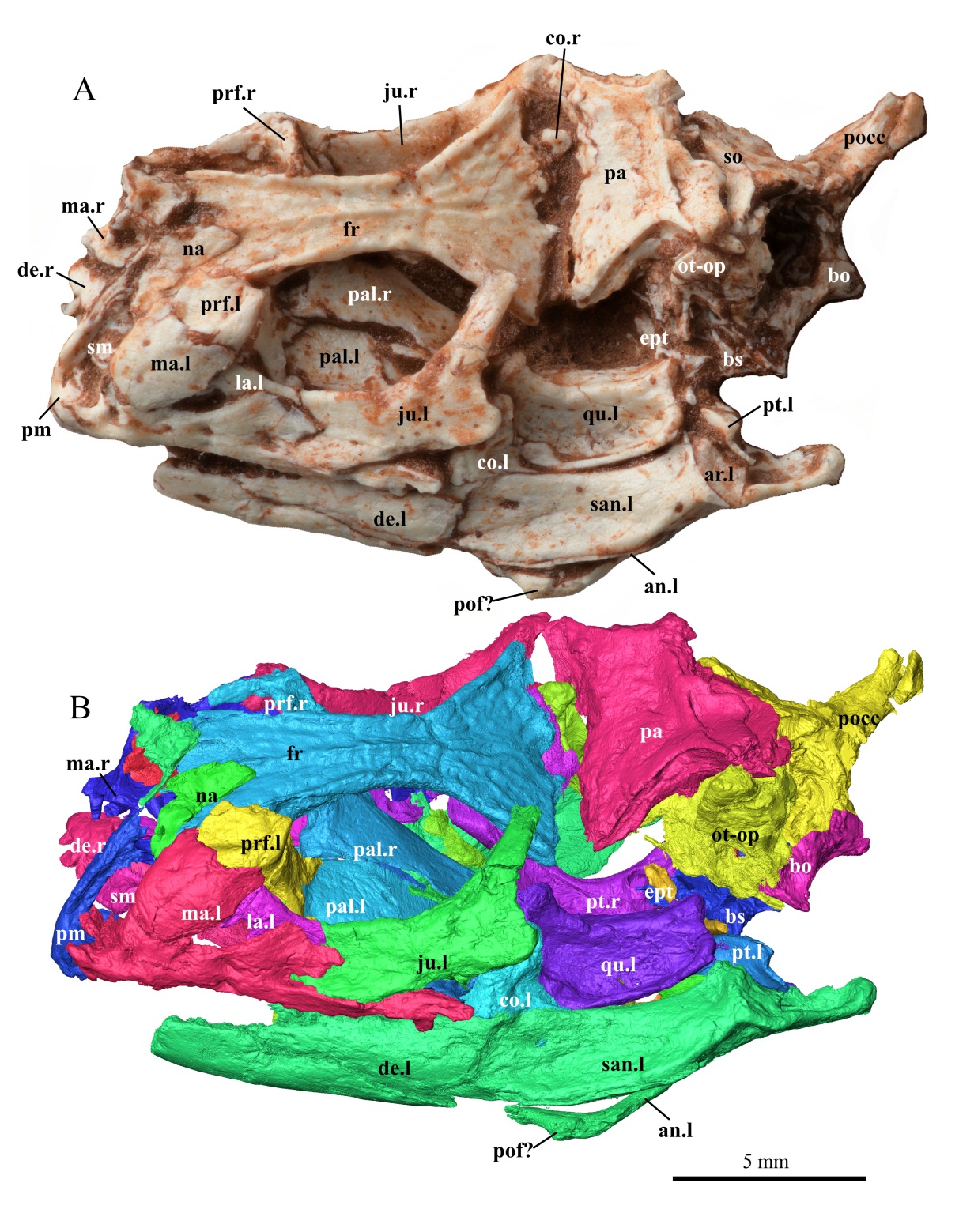
Fig. 1 The newly referred specimen of Funiusaurus luanchuanensis (HGM L2021-1-8) from the Upper Cretaceous Qiupa Formation of Luanchuan, Henan, China A. photograph of the specimen in dorsolateral view; B. 3D rendering of the specimen in the same view Abbreviations: an. angular; ar. articular; bo. basioccipital; bs. basisphenoid; co. coronoid; de. dentary; ept. epipterygoid; fr. frontal; ju. jugal; l. left; la. lacrimal; ma. maxilla; na. nasal; ot-op. otic-occipital; pa. parietal; pal. palatine; pm. premaxilla; pocc. paroccipital process; pof?. possible postfrontal; prf. prefrontal; pt. pterygoid; qu. quadrate; r. right; san. surangular; sm. septomaxilla; so. supraoccipital
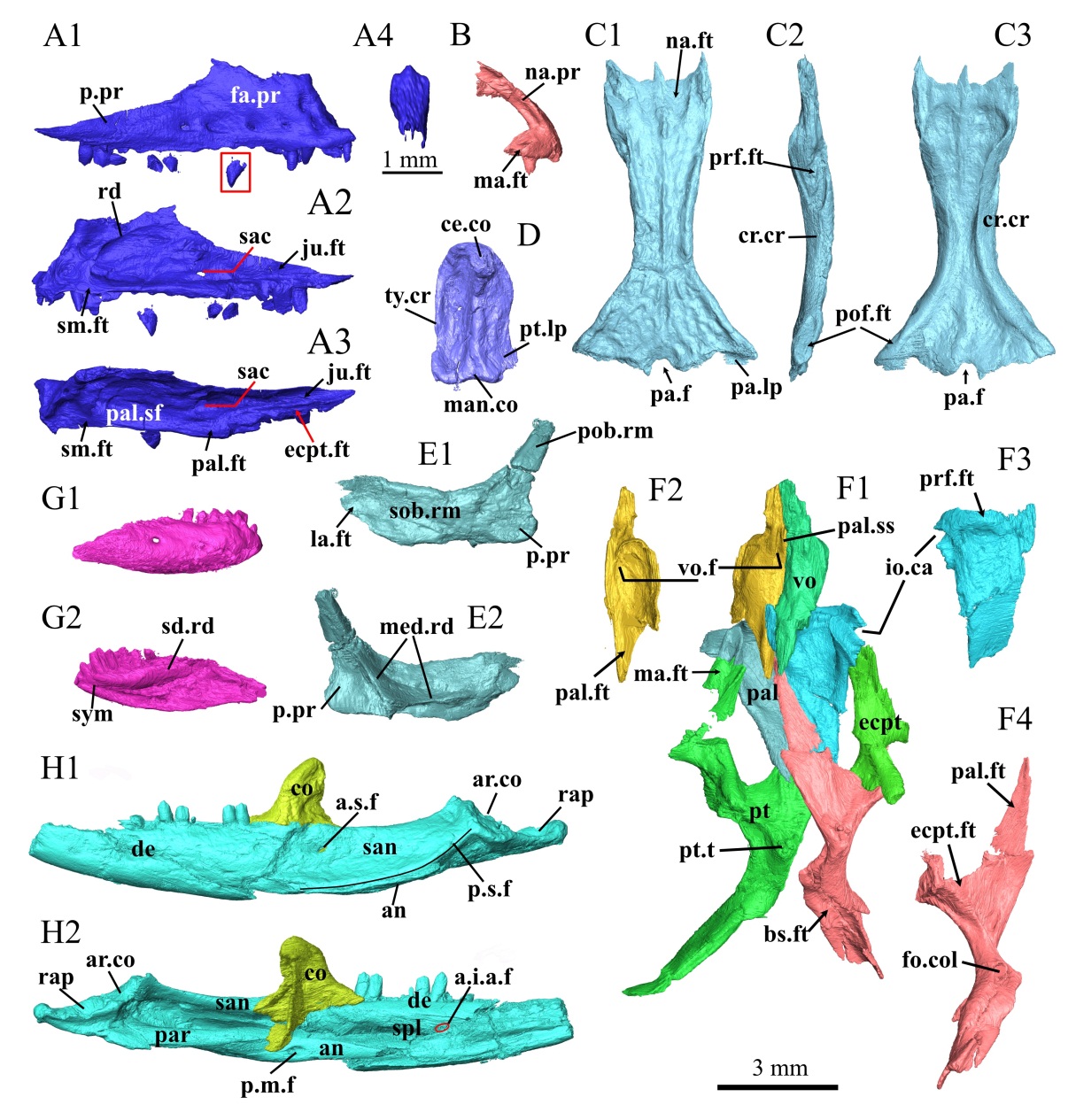
Fig. 2 3D rendering of isolated bones in Funiusaurus luanchuanensis (HGM L2021-1-8) from the Upper Cretaceous Qiupa Formation of Luanchuan, Henan, China A. right maxilla in labial (A1), medial (A2) and dorsal (A3) views and one isolated maxillary tooth (A4) showing the tricuspid nature; the red box in A1 shows where the isolated tooth is from; B. premaxilla in right lateral view; C. frontal in dorsal (C1), left lateral (C2) and ventral (C3) views; D. quadrate in posterior view; E. left jugal in lateral (E1) and medial (E2) views; F. the palate in ventral view (F1), and the vomer (F2), palatine (F3) and pterygoid (F4) in dorsal view; G. anterior portion of the right dentary in labial (G1) and lingual (G2) views; H. left mandible in labial (H1) and lingual (H2) views Abbreviations: a.i.a.f. anterior interior alveolar foramen; a.s.f. anterior surangular foramen; an. angular; ar.co. articular condyle; bs.ft. basisphenoid facet; ce.co. cephalic condyle; co. coronoid; cr.cr. crista cranii; de. dentary; ecpt. ectopterygoid; ecpt.ft. ectopterygoid facet; fa.pr. facial process; fo.col. fossa columellae; io.ca. infraorbital canal; ju.ft. jugal facet; la.ft. lacrimal facet; ma.ft. maxilla facet; man.co. mandible condyle; med.rd. medial ridge; na.ft. nasal facet; na.pr. nasal process; p.m.f. posterior mylohyoid foramen; p.pr. posterior process; p.s.f. posterior surangular foramen; pa.f. parietal foramen; pa.lp. parietal lappet; pal. palatine; pal.ft. palatine facet; pal.sf. palatal shelf; pal.ss. palatine sinus; par. prearticular; pob.rm. postorbital ramus; pof.ft. postfrontal facet; prf.ft. prefrontal facet; pt. pterygoid; pt.lp. pterygoid lappet; pt.t. pterygoid teeth; rap. retroarticular process; rd. ridge; sac. opening of superior alveolar canal; san. surangular; sd.rd. subdental ridge; sm.ft. septomaxilla facet; spl. splenial; sob.rm. suborbital ramus; sym. symphysis; ty.cr. tympanic crest; vo. vomer; vo.f. vomerine foramen
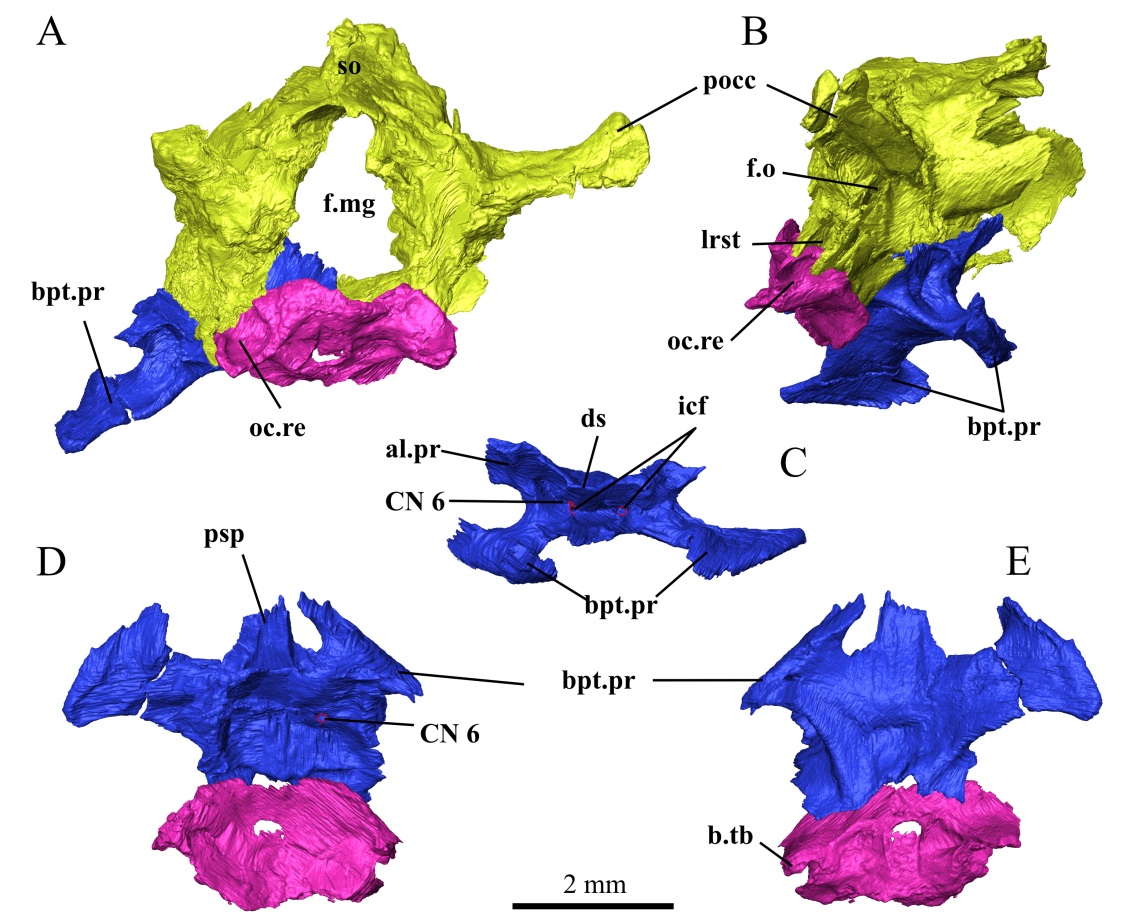
Fig. 3 3D rendering of the braincase in Funiusaurus luanchuanensis (HGM L2021-1-8), from the Upper Cretaceous Qiupa Formation of Luanchuan, Henan, China, in posterior (A) and left lateral (B) views, and restored basisphenoid and basioccipital in anterior (C), dorsal (D) and ventral (E) views Abbreviations: al.pr. alar process; b.tb. basal tubercle; bpt.pr. basipterygoid process; CN6. opening of cranial nerve abducens; ds. dorsum sellae; f.mg. foramen magnum; f.o. foramen ovalis; icf. internal carotid foramen; lrst. lateral opening of resessus scalae tympani; oc.re. occipital recess; pocc. paroccipital process;psp. parasphenoid; so. supraoccipital
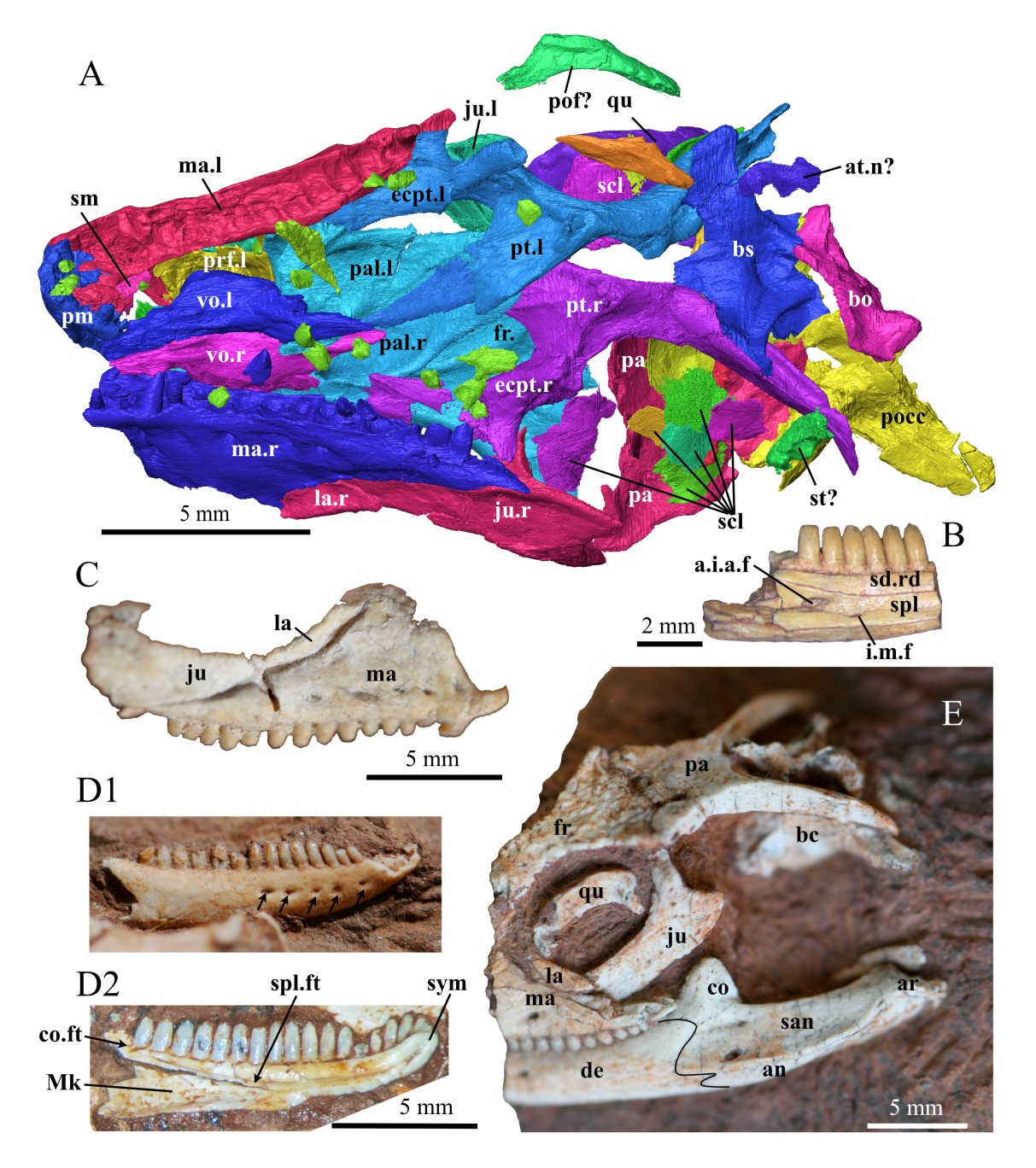
Fig. 4 Additional cranial anatomy of Funiusaurus luanchuanensis from the Upper Cretaceous Qiupa Formation of Luanchuan, Henan, China A. HGM L2021-1-8: 3D rendering of the skull in ventral view after removing the mandibles; B. HGM 1137-2: the middle section of a left mandible in lingual view; C. HGM L08-15: a partial skull in lateral view;D. HGM L2021-1-9: a right dentary in labial view (D1) and a left dentary in lingual view (D2), arrows in D1 point to the mental foramina; E. HGM L2021-1-2: the skull in lateroposterior view Abbreviations: a.i.a.f. anterior interior alveolar foramen; an. angular; ar. articular; at.n?. possible atlas neural arch; bc. braincase; bo. basioccipital; bs. basisphenoid; co. coronoid; co.ft. coronoid facet; de. dentary; ecpt. ectopterygoid; fr. frontal; i.m.f. inferior myhyoid foramen; ju. jugal; l. left; la. lacrimal; ma. maxilla; Mk. Meckelian canal; pa. parietal; pal. palatine; pm. premaxilla; pocc. paroccipital process; pof?. possible postfrontal; prf. prefrontal; pt. pterygoid; qu. quadrate; r. right; san. surangular; scl. scleral ossicles; sd.rd. subdental ridge; sm. septomaxilla; spl. splenial; spl.ft. splenial facet; st?. possible supratemporal bone; sym. symphysis; vo. vomer
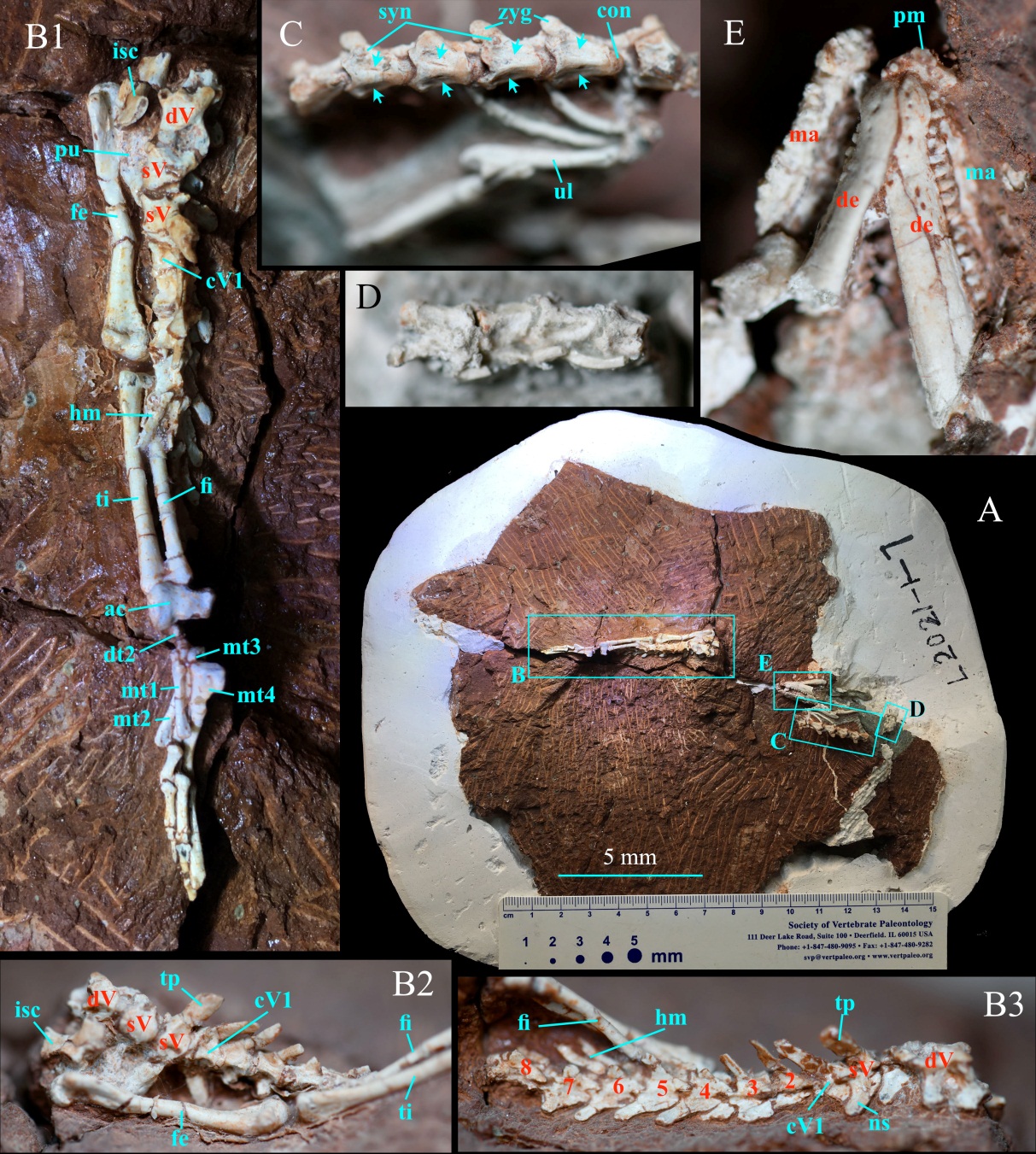
Fig. 5 A referred specimen of Funiusaurus luanchuanensis (HGM L2021-1-7) from the Upper Cretaceous Qiupa Formation of Luanchuan, Henan, China A. the photo of the specimen with rectangles indicating the positions of other subfigures; B. the sacral and anterior caudal vertebral section with the right hind limb in different views (B1-3); C. the articulated dorsal vertebrae in ventrolateral view; D. four cervical or dorsal vertebrae in lateral view; E. the partial skull in ventral view. Abbreviations: ac. astragalocalcaneum; con. condyle; cV. caudal vertebra; de. dentary; dt. distal tarsal; dV. dorsal vertebra; fe. femur; fi. fibula; hm. haemal arch; isc. ischium; ma. maxilla; mt. metatarsal; ns. neural spine; pm. premaxilla; pu. pubis; sV. sacral vertebra; syn. synapophysis; ti. tibia; tp. transverse process; ul. ulna; zyg. zygopophysis
| Region | Taxa | Specimen | Skull length | Mandible length | Tooth type (most complex) | Diet | Reference |
|---|---|---|---|---|---|---|---|
| North America | Polyglyphanodon sternbergi | USNM 15477 | 81.5 | IV | Herbivorous | Gilmore, | |
| Ganzhou | Xenodontolacerta fangi | CVEB20180206 | ~107 | II | Omnivorous | Jiang et al., | |
| Ganzhou | Yechilacerta yingliangia | YLSNHM01791 | ~105 | I | Herbivorous | Xing et al., | |
| Ganzhou | Tianyusaurus sp. | NHMG8502 | 87.4 | I | Herbivorous | Mo et al., | |
| Ganzhou | Caninosaurus ganzhouensis | CUGW VH110 | ~30 | III | Insectivorous | Wang et al., | |
| Gobi | Gilmoreteius ferrugenous | AMNH 6520 | ~115 | I | Herbivorous | Gilmore, | |
| Gobi | Gilmoreteius chulsanensis | ZPAL MgR-I/18 | 80 | I | Herbivorous | Sulimski, | |
| Gobi | Cherminsaurus kozlowskii | ZPAL MgR- III/24 | 65 | I | Herbivorous | Sulimski, | |
| Gobi | Erdenetesaurus robinsonae | ZPAL MgR- III/19 | 55 | I | Herbivorous | Sulimski, | |
| Gobi | Darchansaurus estesi | ZPAL MgR- III/6 | 56 | I | Herbivorous | Sulimski, | |
| Gobi | Tuberocephalosaurus pompabilis | PIN No. 3124/328 | 85 | 75 | I | Herbivorous | Alifanov, |
| Gobi | Aprisaurus bidentatus | PIN No. 3142/302 | ~55 | I | Herbivorous | Alifanov, | |
| Gobi | Campedosaurus sulcularis | PIN No. 3142/341 | ~50.5 | I | Herbivorous | Alifanov, | |
| Gobi | Gobinatus arenosus | IGM 3/126 | 35.2 | III, unicuspid | Insectivorous | Gao and Norell, | |
| Gobi | Tchingisaurus multivagus | IGM 3/129 | 34 | III, tricuspid | Insectivorous | Gao and Norell, | |
| Gobi | Pyramicephalosaurs cherminicus | IGM 3/130 | ~20.9 | III, tricuspid | Insectivorous | Gao and Norell, | |
| Gobi | Conicodontosaurus djadochtaensis | IVPP V10051 | ~25 | III, unicuspid | Insectivorous | Gilmore, | |
| Gobi | Mongolochamops reshetovi | PIN No. 3142/304 | ~43 | III, tricuspid | Insectivorous | Alifanov, | |
| Gobi | Altanteius facilis | PIN No. 3142/306 | ~39 | III, tricuspid | Insectivorous | Alifanov, | |
| Gobi | Barungoia vasta | PIN No. 4487/2 | ~24 | ~23 | III, unicuspid | Insectivorous | Alifanov, |
| Gobi | Gurvansaurus potissimus | PIN No. 3143/104 | 35 | III, unicuspid | Insectivorous | Alifanov, | |
| Gobi | Parameiva oculea | PIN no. 3142/310 | ~20 | III, unicuspid | Insectivorous | Alifanov, | |
| Gobi | Prodenteia ministra | PIN No. 3142/324 | ~18 | III, unicuspid | Insectivorous | Alifanov, | |
| Gobi | Dzhadochtosaurus giganteus | PIN No. 3143/103 | 69 | 53 | III, unicuspid | Insectivorous | Alifanov, |
| Gobi | Cyclurasia multidentata | PIN No. 3142/336 | ~35 | III, ? | Insectivorous | Alifanov, | |
| Gobi | Adamisaurus magnidentatus | IGM 3/117 | 32.2 | III, unicuspid | Insectivorous | Gao and Norell, | |
| Qiupa | Funiusaurus luanchuanensis | HGM 41HIII-114 | ~30 | III, tricuspid | Insectivorous | Xu et al., |
Table 1 Polyglyphanodontian taxa with at least a nearly complete or partial skull preserved: the skull and/or mandible length (when skull not available) of the largest specimen, the tooth type and their diet (mm)
| Region | Taxa | Specimen | Skull length | Mandible length | Tooth type (most complex) | Diet | Reference |
|---|---|---|---|---|---|---|---|
| North America | Polyglyphanodon sternbergi | USNM 15477 | 81.5 | IV | Herbivorous | Gilmore, | |
| Ganzhou | Xenodontolacerta fangi | CVEB20180206 | ~107 | II | Omnivorous | Jiang et al., | |
| Ganzhou | Yechilacerta yingliangia | YLSNHM01791 | ~105 | I | Herbivorous | Xing et al., | |
| Ganzhou | Tianyusaurus sp. | NHMG8502 | 87.4 | I | Herbivorous | Mo et al., | |
| Ganzhou | Caninosaurus ganzhouensis | CUGW VH110 | ~30 | III | Insectivorous | Wang et al., | |
| Gobi | Gilmoreteius ferrugenous | AMNH 6520 | ~115 | I | Herbivorous | Gilmore, | |
| Gobi | Gilmoreteius chulsanensis | ZPAL MgR-I/18 | 80 | I | Herbivorous | Sulimski, | |
| Gobi | Cherminsaurus kozlowskii | ZPAL MgR- III/24 | 65 | I | Herbivorous | Sulimski, | |
| Gobi | Erdenetesaurus robinsonae | ZPAL MgR- III/19 | 55 | I | Herbivorous | Sulimski, | |
| Gobi | Darchansaurus estesi | ZPAL MgR- III/6 | 56 | I | Herbivorous | Sulimski, | |
| Gobi | Tuberocephalosaurus pompabilis | PIN No. 3124/328 | 85 | 75 | I | Herbivorous | Alifanov, |
| Gobi | Aprisaurus bidentatus | PIN No. 3142/302 | ~55 | I | Herbivorous | Alifanov, | |
| Gobi | Campedosaurus sulcularis | PIN No. 3142/341 | ~50.5 | I | Herbivorous | Alifanov, | |
| Gobi | Gobinatus arenosus | IGM 3/126 | 35.2 | III, unicuspid | Insectivorous | Gao and Norell, | |
| Gobi | Tchingisaurus multivagus | IGM 3/129 | 34 | III, tricuspid | Insectivorous | Gao and Norell, | |
| Gobi | Pyramicephalosaurs cherminicus | IGM 3/130 | ~20.9 | III, tricuspid | Insectivorous | Gao and Norell, | |
| Gobi | Conicodontosaurus djadochtaensis | IVPP V10051 | ~25 | III, unicuspid | Insectivorous | Gilmore, | |
| Gobi | Mongolochamops reshetovi | PIN No. 3142/304 | ~43 | III, tricuspid | Insectivorous | Alifanov, | |
| Gobi | Altanteius facilis | PIN No. 3142/306 | ~39 | III, tricuspid | Insectivorous | Alifanov, | |
| Gobi | Barungoia vasta | PIN No. 4487/2 | ~24 | ~23 | III, unicuspid | Insectivorous | Alifanov, |
| Gobi | Gurvansaurus potissimus | PIN No. 3143/104 | 35 | III, unicuspid | Insectivorous | Alifanov, | |
| Gobi | Parameiva oculea | PIN no. 3142/310 | ~20 | III, unicuspid | Insectivorous | Alifanov, | |
| Gobi | Prodenteia ministra | PIN No. 3142/324 | ~18 | III, unicuspid | Insectivorous | Alifanov, | |
| Gobi | Dzhadochtosaurus giganteus | PIN No. 3143/103 | 69 | 53 | III, unicuspid | Insectivorous | Alifanov, |
| Gobi | Cyclurasia multidentata | PIN No. 3142/336 | ~35 | III, ? | Insectivorous | Alifanov, | |
| Gobi | Adamisaurus magnidentatus | IGM 3/117 | 32.2 | III, unicuspid | Insectivorous | Gao and Norell, | |
| Qiupa | Funiusaurus luanchuanensis | HGM 41HIII-114 | ~30 | III, tricuspid | Insectivorous | Xu et al., |
| [1] | Alifanov V R, 1988. New lizards (Lacertilia, Teiidae) from the Upper Cretaceous of Mongolia. Trans Joint Sov-Mongol Palaeontol Exp, 34: 90-100 |
| [2] | Alifanov V R, 1993. New lizards of Macrocephalosauridae from the Upper Cretaceous of Mongolia, with some critical comments to the classification of Teiidae (sensu Estes, 1983). Paleontol Zh, 1993(1): 57-74 |
| [3] | Alifanov V R, 2000. Macrocephalosaurs and the early evolution of lizards of Central Asia. Tr Paleontol Inst Ross Akad Nauk, 272: 1-126 |
| [4] | Benton M J, 2025. The dinosaur boom in the Cretaceous. In: Hart M B, Batenburg S J, Huber B T et al. eds. Cretaceous Project 200. Vol. 1. London: Geological Society of London. 453-475 |
| [5] |
Benton M J, Wilf P, Sauquet H, 2022. The Angiosperm Terrestrial Revolution and the origins of modern biodiversity. New Phytol, 233: 2017-2035
DOI URL |
| [6] |
Carvalho de C J, Santucci R M, 2024. A new fossil Squamata from the Quiricó Formation (Lower Cretaceous), Sanfranciscana Basin, Minas Gerais, Brazil. Cretaceous Res, 154: 105717
DOI URL |
| [7] |
Čerňanský A, Smith K T, Klembara J, 2014. Variation in the position of the jugal medial ridge among lizards (Reptilia: Squamata): its functional and taxonomic significance. Anat Rec, 297: 2262-2272
DOI URL |
| [8] | Conrad J L, 2008. Phylogeny and systematics of Squamata (Reptilia) based on morphology. Bull Am Muse Nat Hist, 310: 1-182 |
| [9] |
Denton R K, O’Neill R C, 1995. Prototeius stageri, gen. et sp. nov., a new teiid lizard from the Upper Cretaceous Marshalltown Formation of New Jersey, with a preliminary phylogenetic revision of the Teiidae. J Vert Paleont, 15: 235-253
DOI URL |
| [10] | Evans S E, 2008. The skull of lizards and tuatara. In: Gans G, Gaunt A S, Adler K eds. The Skull of Lepidosauria. New York: Ithaca. 1-344 |
| [11] |
Evans S E, Manabe M, 2008. An early herbivorous lizard from the Lower Cretaceous of Japan. Palaeontology, 51: 487-498
DOI URL |
| [12] | Fontana M A, 2014. A redescription and phylogenetic analysis of the Cretaceous fossil lizard Polyglyphanodon sternbergi Gilmore, 1940. Master of Science. Washington: The Columbian College of Arts and Sciences, The George Washington University. 1-121 |
| [13] |
Gao K Q, Fox R C, 1991. New teiid lizards from the Upper Cretaceous Oldman Formation (Judithian) of southeastern Alberta, Canada, with a review of the Cretaceous record of teiids. Ann Carnegie Mus, 60: 145-162
DOI URL |
| [14] |
Gao K Q, Fox R C, 1996. Taxonomy and evolution of Late Cretaceous lizards (Reptilia: Squamata) from western Canada. Bull Carnegie Mus Nat Hist, 33: 1-107
DOI URL |
| [15] |
Gao K Q, Norell M A, 2000. Taxonomic composition and systematics of Late Cretaceous lizard assemblages from Ukhaa Tolgod and adjacent localities, Mongolian Gobi Desert. Bull Am Mus Nat Hist, 249: 1-118
DOI URL |
| [16] |
Gauthier J A, Kearney M, Maisano J A et al., 2012. Assembling the squamate tree of life: perspectives from the phenotype and the fossil record. Bull Peabody Mus Nat Hist, 53: 3-308
DOI URL |
| [17] | Gilmore C W, 1940. New fossil lizards from the Upper Cretaceous of Utah. Smithson Misc Collect, 99: 1-3 |
| [18] | Gilmore C W, 1942. Osteology of Polyglyphanodon, an Upper Cretaceous lizard from Utah. Proc US Natl Mus, 92: 229-265 |
| [19] | Gilmore C W, 1943a. Osteology of Upper Cretaceous lizards from Utah, with a description of a new species. Proc US Natl Mus, 93: 209-214 |
| [20] | Gilmore C W, 1943b. Fossil lizards of Mongolia. Bull Am Mus Nat Hist, 81: 361-384 |
| [21] | Hoffstetter R, Gasc J P, 1969. Vertebrae and ribs of modern reptiles. In: Bellairs A D A, Parsons T S eds. Biology of Reptilia, Vol. 1. Morphology A. London and New York: Academic Press. 201-310 |
| [22] | Jiang J, Bi S D, Dai R M et al., 2025. Taxonomy and phylogeny of Polyglyphanodontia (Squamata): a comprehensive review. Acta Palaeontol Sin, 64: 84-99 |
| [23] | Jiang J, Dong L P, Xu X et al., 2026. A new polyglyphanodontian lizard from the Upper Cretaceous of southern China implies a complex evolutionary history of the clade. Roy Soc Open Sci, 13: 252253 |
| [24] |
Klembara J, Hain M, Dobiašová K, 2014. Comparative anatomy of the lower jaw and dentition of Pseudopus apodus and the interrelationships of species of subfamily Anguinae (Anguimorpha, Anguidae). Anat Rec, 297: 516-544
DOI URL |
| [25] | Lloyd G T, Davis K E, Pisani D et al., 2008. Dinosaurs and the Cretaceous Terrestrial Revolution. Proc R Soc B: Biol Sci, 275: 2483-2490 |
| [26] |
Longrich N R, Tokaryk T, Field D J, 2011. Mass extinction of birds at the Cretaceous-Paleogene (K-Pg) boundary. Proc Nat Acad Sci USA, 108: 15253-15257
DOI URL |
| [27] | Martinelli A G, Agnolin F L, Ezcurra M D, 2021. Unexpected new lizard from the Late Cretaceous of southern South America sheds light on Gondwanan squamate diversity. Rev Mus Argentino Cienc Nat, 23: 57-80 |
| [28] |
Melstrom K M, Irmis R B, 2019. Repeated evolution of herbivorous crocodyliforms during the age of dinosaurs. Curr Biol, 29: 2389-2395
DOI PMID |
| [29] | Mo J Y, Xu X, Evans S E, 2010. The evolution of the lepidosaurian lower temporal bar: new perspectives from the Late Cretaceous of South China. Proc R Soc B: Biol Sci, 277: 331-336 |
| [30] | Nydam R L, 2013a. Lizards and snakes from the Cenomanian through Campanian of Southern Utah:filling the gap in the fossil record of Squamata from the Late Cretaceous of the Western Interior of North America. In: Titus A L, Loewen M A eds. At the Top of the Grand Starcase: the Late Cretaceous of Southern Utah. Bloomington, Indiana: Indiana University Press. 370-423 |
| [31] |
Nydam R L, 2013b. Squamates from the Jurassic and Cretaceous of North America. Palaeobiodivers Palaeoenviron, 93: 535-565
DOI URL |
| [32] |
Nydam R L, Cifelli R L, 2002. A new teiid lizard from the Cedar Mountain Formation (Albian-Cenomanian boundary) of Utah. J Vert Paleont, 22: 276-285
DOI URL |
| [33] |
Nydam R L, Caldwell M W, Fanti F, 2010. Borioteiioidean lizard skulls from Kleskun Hill (Wapiti Formation; upper Campanian), west-central Alberta, Canada. J Vert Paleont, 30: 1090-1099
DOI URL |
| [34] |
Pyron R A, 2017. Novel approaches for phylogenetic inference from morphological data and total-evidence dating in squamate reptiles (lizards, snakes, and amphisbaenians). Syst Biol, 66: 38-56
DOI PMID |
| [35] | Reeder T W, Townsend T M, Mulcahy D G et al., 2015. Integrated analyses resolve conflicts over squamate reptile phylogeny and reveal unexpected placements for fossil taxa. PLoS One, 10: e0118199 |
| [36] |
Roelants K, Gower D J, Wilkinson M et al., 2007. Global patterns of diversification in the history of modern amphibians. Proc Nat Acad Sci USA, 104: 887-892
DOI URL |
| [37] | Russell A P, Bauer A M, 2008. The appendicular locomotor apparatus of Sphenodon and normal-limbed squamates. In: Gans C, Gaunt A S, Kraig A eds. The Skull and Appendicular Locomotor Apparatus of Lepidosauria. New York: Ithaca. 1-466 |
| [38] |
Simões T R, Funston G F, Vafaeian B et al., 2016. Reacquisition of the lower temporal bar in sexually dimorphic fossil lizards provides a rare case of convergent evolution. Sci Rep, 6: 24087
DOI PMID |
| [39] | Sulimski A, 1975. Macrocephalosauridae and Polyglyphanodontidae (Sauria) from the Late Cretaceous of Mongolia. Palaeontol Pol, 33: 25-102 |
| [40] | Vullo R, Rage J C, 2018. The first Gondwanan borioteiioid lizard and the mid-Cretaceous dispersal event between North America and Africa. Sci Nat, 105: 160462 |
| [41] |
Wang M L, Dong L P, Yu J et al., 2025. A new borioteiioid lizard with large caniniform tooth from the Upper Cretaceous of South China. J Syst Palaeont, 23: 2509637
DOI URL |
| [42] |
Xing L D, Niu K L, Evans S E, 2023. A new polyglyphanodontian lizard with a complete lower temporal bar from the Upper Cretaceous of southern China. J Syst Palaeont, 21: 2281494
DOI URL |
| [43] | Xu L, Wu X C, Lu J C et al., 2014. A new lizard (Lepidosauria: Squamata) from the Upper Cretaceous of Henan, China. Acta Geol Sin - Engl Ed, 88: 1041-1050 |
| [1] | 朱旭峰, 常飞, 李雨, 张旭晃, 高殿松, 王强, 裘锐, 汪筱林, 刘迪, 贾松海, 贾广辉, 张建华, 徐莉. 潭头盆地上白垩统秋扒组首次发现非鸟恐龙蛋窝(瑶屯巨形蛋,长形蛋科). 古脊椎动物学报, 2025, 63(2): 159-172. |
| [2] | 周明笑, 严允, 邱文江, 方开永, 朱旭峰, 王强, 汪筱林. 江西武宁石笋蛋类恐龙蛋蛋窝的发现. 古脊椎动物学报, 2023, 61(4): 317-325. |
| [3] | 王强, 邢浩, 石海涛, 方开永, 朱旭峰, 周明笑, 汪筱林. 哈密南湖戈壁首次发现恐龙蛋. 古脊椎动物学报, 2022, 60(4): 324-327. |
| [4] | 方开永, 刘清华, 王强, 朱旭峰, 邓里, 刘遇春, 文军, 汪筱林. 江西上高石笋蛋类恐龙蛋的发现. 古脊椎动物学报, 2022, 60(1): 69-78. |
| [5] | 秦子川, 赵祺, 徐星. 张氏西峡爪龙(兽脚类:阿尔瓦雷斯龙类)第二跖骨的骨组织学及其对“窄足型”足部结构发育的启示. 古脊椎动物学报, 2019, 57(3): 205-213. |
| [6] | 朱旭峰, 方开永, 王强, 卢筱洪, 吴伟强, 杜衍礼, 黄志青, 汪筱林. 广东三水盆地发现首个始丰石笋蛋(Stalicoolithus shifengensis)蛋窝. 古脊椎动物学报, 2019, 57(1): 77-83. |
| [7] | 王 强,李雨光,朱旭峰,方开永,汪筱林. 山东莱阳晚白垩世棱柱形蛋新属种及其意义. 古脊椎动物学报, 2018, 56(3): 264-272. |
| [8] | 续世朝,尤海鲁,王嘉玮,王锁柱,伊 剑, 贾 磊. 山西天镇晚白垩世一新鸭嘴龙超科恐龙. 古脊椎动物学报, 2016, 54(1): 67-78. |
| [9] | 姚熙,王孝理,舒柯文,王烁,Thomas STIDHAM,徐星. 内蒙古二连盆地二连组亚洲近颌龙(兽脚类:窃蛋龙类)一未定种. 古脊椎动物学报, 2015, 53(4): 291-298. |
| [10] | 谭庆伟 ,邢海 ,胡永国 ,谭琳 ,徐星 . 湖北上白垩统马家村组的鸭嘴龙超科新材料. 古脊椎动物学报, 2015, 53(3): 245-264. |
| [11] | 莫进尤,徐 星. 江西晚白垩世大型兽脚类恐龙牙齿. 古脊椎动物学报, 2015, 53(1): 63-72. |
| [12] | 徐 星,Michael PITTMAN,舒柯文, Jonah N. CHOINIERE,谭庆伟,James M. CLARK,Mark A. NORELL,王 烁. 晚白垩世精美临河盗龙(Linheraptor exquisitus)的分类位置. 古脊椎动物学报, 2015, 53(1): 29-62. |
| [13] | 刘金远,王 强,赵资奎,汪筱林,高春玲,沈才智 . 辽宁昌图上白垩统泉头组恐龙蛋化石的分类订正. 古脊椎动物学报, 2013, 51(4): 278-288. |
| [14] | 邹松林,王强,汪筱林. 江西萍乡地区晚白垩世副蜂窝蛋类一新蛋种. 古脊椎动物学报, 2013, 51(2): 102-106. |
| [15] | 王 强,赵资奎,汪筱林,张蜀康,蒋 严根. 浙江天台盆地晚白垩世网形蛋类新类型及网形蛋类的分类订正. 古脊椎动物学报, 2013, 51(1): 43-54. |
| 阅读次数 | ||||||
|
全文 |
|
|||||
|
摘要 |
|
|||||
